Let’s Liberate Diversity! News

ENAF launch

Press Release: Launch of the European Network of Agroecological Food Systems

On January 26th, the Horizon 2020 Project, Agroecology for Europe (AE4EU) launched ENAF: the European Network for Agroecological Food Systems, along with more than 40 esteemed colleagues and fellow associations.

We came together to discuss activating the combined potential and capabilities of existing national and European networks to be able to contribute more effectively across sectors to agroecological transformations of farming and food systems in Europe, in a way that is bottom-up, transdisciplinary, and embraces all agroecological elements and principles.

The day began with the inspirational words of Professor Pablo Tittonell who spoke of bringing agroecology from the niche to the mainstream, sharing with us experiences from Argentina. It included examples of collaboration between municipalities and local farmers which altered the food system in such a way where farmers received 60% of profits, which made it possible to not only sustain agroecological practices, but also to sell agroecological food at a price that is affordable for all. Today this model involves 22,334 families out of the 31,393 family farms that are established in Argentina.

Pablo also stressed that the transition needs to be just, with no farmers left behind or we risk a feedback loop that returns to conventional agriculture. This message was shared by the consortium within group discussions, as farmer representation is seen to be of utmost importance in the future of ENAF.

The event continued with Attila Szocs of Eco Ruralis, and Jesse Donham of Agroecology Europe, who shared a conversation on the importance of more activate involvement with Eastern European farmers. Within Eastern Europe there are over 10 million farmers, most of them peasant farmers who keep agroecology alive, making them vital components of any transition.

Attila stated that “through agroecology, we unite” and nothing could show this more than through the collaborations that have begun amongst Eastern European countries in response to the war in Ukraine. While Member States in the EU have used this moment to strip back environmental policy, such a crisis is showing the importance of food sovereignty and agroecology, since it is local peasant farmers that have stayed behind to feed the population when industrial agriculture left.

Klarien Klingen, of the Dutch Federation of Agroecological Farmers, stressed the importance of creating a movement. She presented her own experience of doing so when various agroecological farming associations joined forces with each other, and with researchers and NGO’s, to create the federation. An important step which allows them to influence policies.

Finally, the Agroecology Europe Hub was presented as a key component of ENAF – a tool to connect agroecological farmers, researchers, students, policy-makers and funders by sharing content, information, news, stories, courses and living labs. This is meant to create connections all across Europe to guide the agroecological transition.

While ENAF was launched by AE4EU, its further establishment will take place through a co-creative process and related activities will be handed over to another founding member (yet to be identified) by the end of 2023. This process will be guided by two working groups which are open to any network representative that is interested.

ENAF seeks to complement what networks are doing by creating synergies and supporting shared efforts so that the efficacy of their work is enhanced. This includes creating opportunities for a stronger, combined voice and influence in relation to policy and research agendas. Additionally, it allows ideas to spread more rapidly across national boundaries, thus supporting local innovation.

ENAF understands agroecology as an integrated food system approach that pays due attention to both its social, economic, and environmental aspects. The vision of ENAF is to see people across Europe enjoying all the good that comes with food systems that are grounded in the principles of agroecology since they are environmentally conscious, socially just and economically fair.

ENAF acknowledges the tendency for top-down guidance on sustainability transitions in agriculture and food in Europe, and seeks to complement this by being principally orientated towards the knowledge and voice of agroecological food producers all over Europe. This European diversity in agroecology – from peasant farming to regenerative practices and community partnerships – are recognised as strong bedrocks for a holistic transformation of the European food systems.

More details on ENAF, its next steps, opportunities for joining, and outputs from the launch can be found on: https://www.ae4eu.eu/european-network-for-agroecological-food-systems/

For more information, and/or if you would like to join ENAF, please contact: jessica.donham@agroecology-europe.org or seerp.wigboldus@wur.nl

Panel theGreensEFA

Which seeds for a just transition to agroecological and sustainable food systems?

The current EU Seed Marketing regulations date back to the 1960s and draw on principles that go back even further to the first decades of the 20th century, when some European countries started to introduce seed certification rules. The objective of the regulation was to ensure that propagation material complied with quality standards and that seed was identifiable with certainty. While successful in achieving their goals, the EU regulations have had an undesirable effect: the diversity of seed available to growers fell sharply.

Despite amendments over the years, the EU regulations still fall short of supporting agrobiodiversity: they are after all deeply rooted in ideas of uniformity (DUS criteria) and productivity in terms of yield size (VCU criteria) that are linked to the industrialisation of agriculture. Their complexity favours a centralised ‘formal’ seed system, rather than supporting the smaller, on-farm and amateur stakeholders, known as the ‘informal’ seed system. The latter, however, are a stalwart of the agroecological transformation of food systems, which is necessary to address and mitigate the consequences of climate change.

The EU seed marketing legislation needs a fundamental reform to re-balance the industrial crop production system with more local and low-input production systems such as agroecological and organic
production. It also needs to make the European Green
Deal a reality, supporting more sustainable agricultural practices, reversing the loss of crop biodiversity
and diversifying the food in consumers’ plates.

Prieler, M. (2022) EU reform of seeds marketing rules:
Which seeds for a just transition to agroecological
and sustainable food systems?,
The Greens/EFA
, p.43

While the EU Commission first attempted a major reform to harmonise and improve the regulations a decade ago, their proposal was unsuccessful at the time. A new proposal is being drafted at the moment.

The purpose of this event was to discuss and provide inputs from an agroecological perspective, and the large part of the discussion pivoted around two main topics: the definition of seed marketing and GMOs. I will briefly outline those below.

While seeds are impacted by legislation in several domains, both at the EU level and internationally (ie innovation and intellectual property: IPR/patents; biodiversity ie ITPGRFA), the EU deals with seeds mainly through the EU Seed Marketing legislation. However, the scope of what marketing means is not clearly defined. Some – but by no means all – Member States have implemented their own legislation exempting amateur use and sharing of seeds from marketing regulation (ie France, Denmark). According to Arche Noah, the EU should make the distinction between commercial and amateur use clear, by restricting its legislative domain to commercial seeds only. Others, such as organic membership organisation IFOAM, maintain that the line between amateur and commercial stakeholders is not so clear cut, for example when small organic producers are concerned.

As for Genetically Modified Organisms (GMOs), the debate revolves around so-called New Breeding Techniques (NBTs): the new generation of genetic techniques (ie CRISPR), which proponents maintain are substantially different from GMOs and should therefore be exempted from biosafety regulation, which restricts use and requires labelling of seeds and derived products. Deregulation of NBTs would however mean less transparency for citizens and farmers, who would be unable to exercise their choice based on ethical standards and precautionary principle (ie in the case of the organic movement). Moreover, the freedom of farmers and small breeders to use seeds would be constrained by the risk of intellectual property infringement, as genetic material produced in a lab is also generally protected under patenting and restrictive IPRs.

Front cover of the political study

The study is now available online for all to read. In the next few paragraphs, I want to highlight some other reflections from the event, for those that were not attending.

  • Miriam Staudte Minister of AG Lower Saxony: seeds are essential to the sustainability of food systems, yet they hardly feature in sustainability discussions, as compared for example to soil.
  • Sarah Wiener MEP: the uniformity of the food available to us leaves citizens unable to imagine the sheer variety of produce that exists. As an example: tomatoes are the most popular vegetable in Germany, but how many sorts of tomatoes can anyone name? There are thousands of different varieties in the world, in all colours, shape and sizes, with their own different uses! Unaware, we cannot claim diversity for our diets, let alone demand that diversity is protected per se.
  • Riccardo Bocci, Rete Semi Rurali (IT): the best variety is the variety that works best in your specific conditions, as there is no universal definition of value for a specific plant. However, the current EU regulation implies superiority of varieties based on crop yield size. This is an outdated agronomical concept, in particular when considering cultivation on marginal land such as the Italian mountainous regions. Low-input varieties (which are usually considered less productive) can in fact produce more under such conditions than modern varieties (which are designed to be highly productive only under high-input growing conditions). In making these considerations, Riccardo was picking up a comment from the audience, which pointed out how the DUS (Distinctness, Uniformity and Stability) and VCU (Value for Cultivation and Use) criteria in the EU Seed Marketing regulations combine to pitch candidate seed varieties against each other in the competition for access to the European Seed Catalogue, forcing a sort of one-way ‘genetic progress’.
  • Annika Michelson, Maadjas (EE): Estonia is considered marginal land because of its climatic conditions, so Annika also argued against defining value in terms of crop yield size and made an example from research on old varieties. These were tested for mineral content and found to be richer than modern varieties. It is known from previous research that old varieties are richere in protein too. Nutrient density appears therefore to be overall higher in old varieties, which prompted her question: do we need so much food that is not very nutritious, or would we be better off with less food, but more nutritious?

The EU commission draft proposal for reform of the EU Seed Marketing rules is expected in June 2023.

ITPGRFA logo

ITPGRFA: Outcomes of 9th Session of the Governing Body

The Food and Agriculture Organisation (FAO) has published the final Report and the seventeen Resolutions adopted by the Ninth Session of the Governing Body (New Delhi, September 2022) of the International Treaty on Plant Genetic Resources for Food and Agriculture.

Among the resolutions, the Session, which acknowledged and celebrated the contributions of all guardians, curators and users of crop diversity including farmer-breederes and their collaborative initiatives (Resolution 1), encouraged the implementation of Article 9 on Farmers’ Rights and proposed changes to the Multilateral Access and Benefit Sharing System, also considering the impact of digital sequence information on the latter.

For more background information on Farmers’ Rights in the Treaty, check our past Seed Policy Dialogue meeting!

Farmers’ Rights background and implementation
Implementation of Farmers’ Rights in Europe: Considerations for discussion

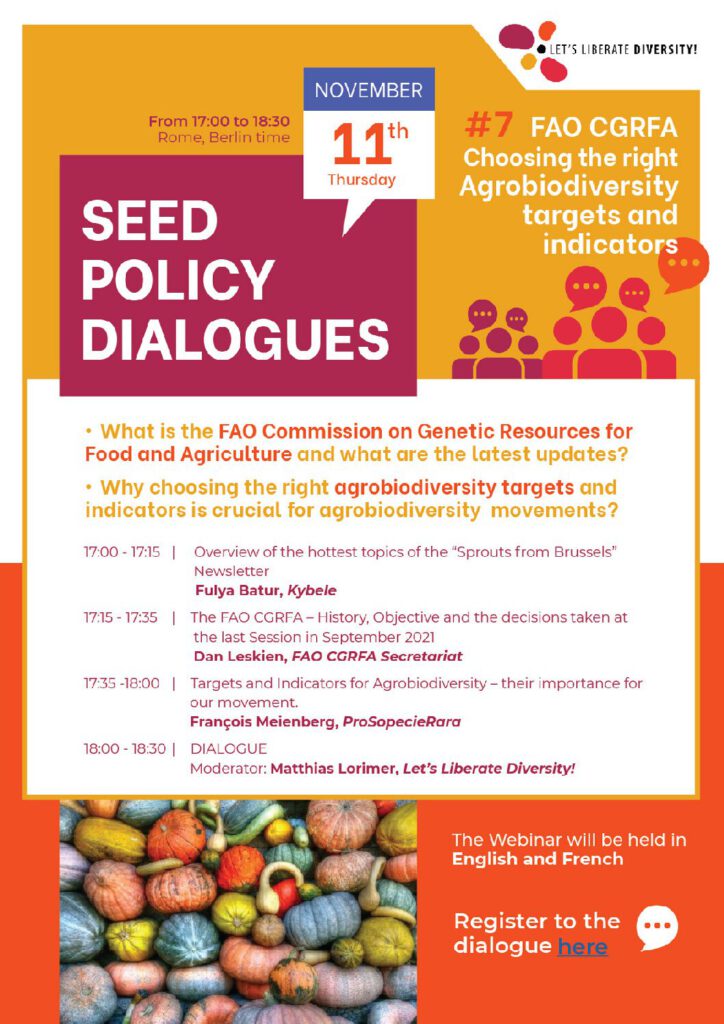
SPD#7: FAO CGRFA, Agrobiodiversity targets and indicators

In November 2021, the SPD analysed the FAO Commission on Genetic Resources for Food and Agriculture (CGRFA), and more particularly its work on agrobiodiversity targets and indicators, asking why the right indicator choice is crucial for agrobiodiversity movements. It was enriched by contributions from Dan Leskien, from the FAO CGRFA Secretariat, and François MEIENBERG, from Pro Specie Rara.

You can watch the presentation on the history & objectives of the CGRFA, along with the latest decisions taken in September 2021, and the importance of targets and indicators for the agrobiodiversity movement (in English).

The FAO Commission on Genetic Resources for Food and Agriculture – History objective and the decisions taken at the last Session in September 2021? – Dan Leskien

Targets and indicators for agrobiodiversity: their importance for our movement – Francois Meienberg

SPD#6: UNDROP, Farmers’ rights to seeds and biodiversity

In October 2021, the SPD focused on the United Nations Declaration on the Rights of Peasants and People living in rural areas (UNDROP), asking which rights peasants have in this context, and a recollection of the lengthy mobilization by farmers’ and civil society organizations that led to the adoption of the UNDROP. It was enriched by presentations from Christophe Golay, from the Geneva Academy, and Guy Kastler, from the European Coordination la Via Campesina. You can watch the general presentation of the UNDROP and its provisions on the rights to seeds (in English), and the pathways for the incorporation of peasants’ rights to seeds in the European context (in French).

The “Right to seeds in the UN Declaration on the Rights of Peasants” – Christophe Golay

What is the UNDROP United Nations Declaration and what Rights do Peasants have within this context? In this video Dr. Christophe Golay Senior Research Fellow and Strategic Adviser on ESC RightsGeneva Academy of International Humanitarian Law and Human Rights, will explain the history and the potential use of the Declaration.

Incorporating peasants’ rights to seeds in European Law – Guy Kastler

After 40 years of mobilizations, what is the future of peasants’ seed rights? In this video Guy Kastler from ViaCampesina is explaining the ViaCampesina path.

Useful links:

https://www.geneva-academy.ch/joomlatools-files/docman-files/UN%20Declaration%20on%20the%20rights%20of%20peasants.pdf

seed exchange

MAKING SEED SAVERS REGISTER COULD SLASH THE SAVING OF SEEDS! – Petition

The Petition

EU authorities should recognize that seed savers are important for the conservation of varieties and exempt them from plant health registration. Some seed savers in Europe have already given up saving seeds. They can no longer continue to make seeds or other plant reproductive material available in a legal manner, and they do not want to do it illegally.

However, the conservation of cultivated plant diversity in most European countries depends on such individual seed savers. 

With its Plant Health Regulation, the EU intends to control the spread of plant pests by enabling Plant Health Offices to search everywhere for viruses, bacteria, fungi or insects, even in gardens and on the premises of seed savers who share rare plant propagation material with interested people via web shops. The EU put in force an elaborate control system a few years ago. They are are currently re-evaluating their provisions regarding web shops. This is the opportunity for seed savers to ring alarm bells.

General control of those who are hobby gardeners is not the intention of this regulation. However, persons who are conserving cultivated plant biodiversity and are using web shops to reach out to like-minded people, now have to register. This is likely to affect the majority of seed savers in most EU countries. Registered persons and organisations have to fulfill certain obligations such as: knowing EU regulations, ensuring traceability, and allowing for eradication of plants found to carry pests. They can also pay an authorized operator to do it for them. For some plants particularly susceptible to certain pests, among them tomatoes and beans, plant passports have to be issued for each web shop sale.

Due to the tiny size of the lots, extra administration costs would increase the price of diversity seeds, considerably more than for mass commercial seed varieties. A cost recovery scheme would not help, because even this means extra administration. Also, any “lighter regulation” as proposed by some would not help, as it would still require the registration of people engaged in the conservation of diversity. Seed savers have neither the time nor the money for extra administration. They already have plants and possible pests under close scrutiny, since they don’t want to lose any plant from which they have chosen to harvest seed. Only operators with paid staff have so far been able to cope with just some of the legal requirements.

However, it would cut cultivated plant diversity from its roots, if throughout Europe it was conserved by only a handful of organisations with paid staff. The local engagement of many people in cultivating plant diversity must remain movement in society. It requires many gardens and many people to love, care for and develop the living cultural heritage adapted to local conditions and then hand it over to the next generation. Who would get engaged if expensive seed and official registration were needed from the start?

Reason

The seed saving community prevents rather than eradicates pests. They care for healthy soils, with mixed cultivation, crop rotation, an environment that strengthens naturally occurring beneficial predators and therefore also increases the vitality and adaptability of the plants. With their broad genetic base, diverse varieties are able to withstand stress. A good example is the German apple variety “Edelborsdorfer” which for 600 years has been free of any damage from scab, the most important disease in European commercial apple cultivation.

The fact that old varieties lack modern “resistance genes”, is hardly a disadvantage. Such resistance genes are single genes that can be broken by pests or diseases adapting to them. Monocultures encourage pests to multiply and sometimes develop and spread new variants. Even diversity varieties can be affected.

Diversity varieties, however are often not affected by the presence of a virus or other pest. To eradicate these healthy plants would be a serious mistake if the EU Regulation truly aims at better plant health.

Some of the seed savers have not only cancelled their web shops, but also ceased their activity. Without web shops, the sale of tomato and bean seed in particular, dubbed as „diversity diplomats“ due to their importance and attractiveness, the cultivation of numerous varieties and many other species would be reduced to a fraction of what is grown today in gardens and fields. More damage to diversity is likely if seed savers are not immediately and completely exempted from the official registration obligation under Plant Health Regulation EU 2016/2031.

Diversity varieties are a necessity, not a risk, as some are claiming. Imposing the registration obligation on seed savers using web shops could deeply damage diversity conservation and does little to help to avoid plant health problems in the EU.

See also: https://www.openpetition.eu/petition/online/free-seed-exchange-for-savers-of-seed-diversity

Thank you for your support, Dachverband Kulturpflanzen- und Nutztiervielfalt e.V. from Bonn

No Results Found

The posts you requested could not be found. Try changing your module settings or create some new posts.

May 2026
No event found!
Load More

Video