Let’s Liberate Diversity! News
IPES-Food briefing on increasing concentration of corporate power in the food system
IPES Food latest work presents an clear picture of the concentration of power in most segments of the agri-food system, where just a few corporate players dominate markets.
According to the report, there are several mechanisms that keep this trend in place in the food system, including the possibilities that large corporations have to:
- Gaining ‘market power’ through consolidation
- Using economic dominance to exercise political power
- Shaping scientific research and popular discourse through sponsorship and their
- Shaping trade and investment treaties and agreements
Large corporations have undue influence over global food governance, undermining people’s abilities to engage with food systems on their own terms and eroding their human rights
Recommendation for addressing power imbalances in the food system governance
The report concludes with a series of reccomendations listed in teh figure below

The report is accessible here
M.Pimbert – Transforming food and agriculture
The paper:
“Transforming food and agriculture: competing visions and major controversies” is available to download for free.
It compares and contrasts the mainstream and agroecological approaches to the transformation of food systems, analysing some of the principles the two models draw from.
This paper starts by briefly describing two contrasting models of development that seek to radically transform food, farming, and land use today [… and…] highlights some of the controversies and challenges associated with each of these two contrasting approaches to agri-food system transformation.
Pimbert, M. (2022). Transforming food and agriculture: Competing visions and major controversies. Mondes en développement, 199-200, 361-384. https://doi.org/10.3917/med.199.0365
Pimbert argues that the mainstream approach, and the technological innovations it promotes, “represent a truly fundamental rupture with previous agricultural practices”, exactly as argued by its promoters; however, they “show a remarkable historical continuity with the logic of capitalist accumulation”, with its principles of “uniformity, centralisation, privatisation, concentration of power, control and coercion.” (p. 363)
Agroecology, on the other hand, is “based on principles of diversity, decentralisation, distributed power, dynamic adaptation, and democracy”; its advocates “emphasise a radical transformation of the system for autonomy, mutualities of care, and democracy.” (p. 365)
The paper goes on to analyse the following core differences between the two models:
- Modernity, technology and labour
- Knowledge and ways of knowing
- Nature-Based Solutions, global finance and the metabolic rift
- Economic development vs economies of care
- Governance, democracy and corporate capture
and concludes that a more democratic approach to defining visions for the future is desirable.
Seeding tomorrow
The Gaia Foundation Seed Sovereignty Programme published a video looking at Irish growers who, amongst the chaos of Brexit and climate change, are chasing security and hope for the future by returning to growing and saving seed. Seeds and people have shaped each...
Representing LLD at the 16th ECPGR meeting in Malmö, Sweden: a report from Sesam
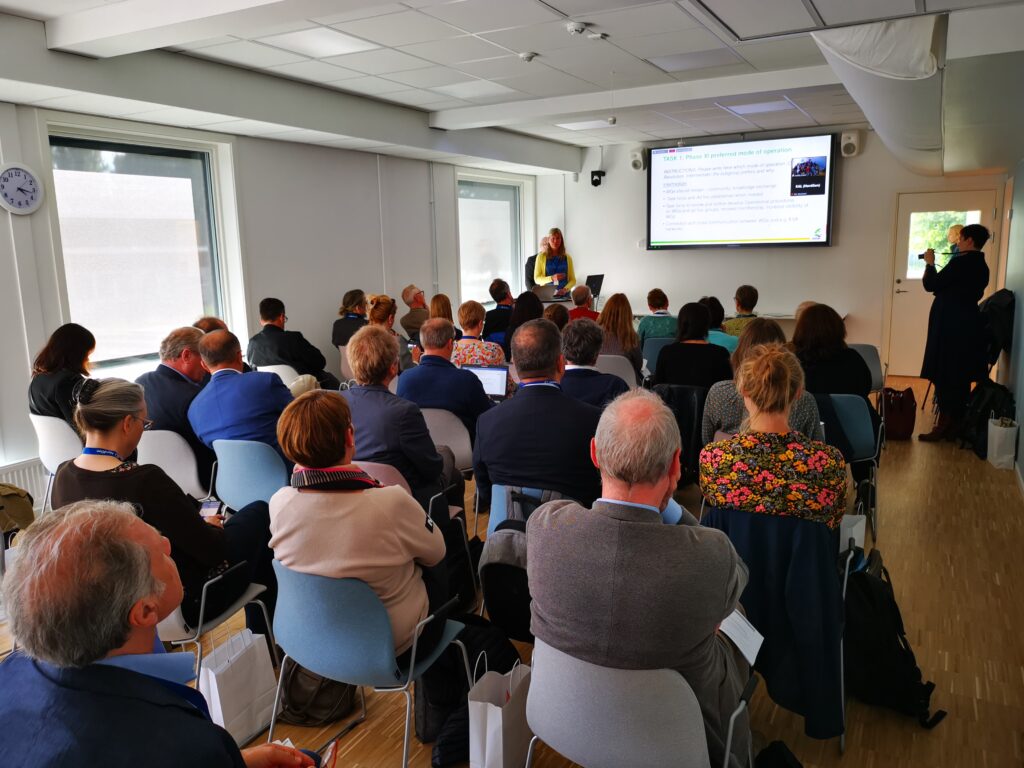
The 7-9th of June I was honoured with the opportunity to participate in the 16th ECPGR meeting as an observer on behalf of the Let’s Liberate Diversity! network. ECPGR stands for European Cooperative Programme for Plant Genetic Resrources and aims at conserving ex situ and in situ plant genetic resources, providing access and increasing their sustainable use. The meeting was held at a conference centre in Malmö and the facilities of NordGen in Alnarp, Sweden. Participants were national representatives, often working in the respective national gene banks, agricultural research institutes, or ministries of agriculture.
How ECPGR works and the content of the 16th meeting
ECPGR divides its development into phases that are initiated by deciding certain goals and ambitions and then dedicating the phase to fulfilling them. This meeting was discussing the ongoing phase X (2019-2023), and how to move into phase XI. Hence, presentations and workshops were mainly focusing on achievements and conclusions from the ongoing phase and setting ambitions for the next one. ECPGR also operates through working groups addressing the interests of different crop categories and other thematic categories such as in situ conservation of crop wild relatives, cryopreservation, and on farm conservation. ECPGR is publicly funded and further in-depth information on their activities is easily accessible on their website (www.ecpgr.cgiar.org), including a report from this meeting

What are AEGIS, EVA and EURISCO?
Some of the results of the ECPGR collaboration are the establishment of AEGIS, EVA, and EURISCO. These are databases that intend to facilitate conservation strategies, accessibility, and utilization of the plant genetic resources. AEGIS (A European Genebank Integrated System) aims at listing accessions from each gene bank that are unique to their collection and local area. This way a European collection can be established with a defined common standard for conservation and accessibility, as well as cost sharing as the utilization could be of interest within all of Europe. EVA (European Evaluation Network) aims at increasing the use of crop genetic diversity and the diversity of stakeholders in plant breeding. Through public-private collaborations evaluation data is collected and published. The EVA is working through crop specific networks currently active for carrots, lettuce, maize, wheat and barley, and peppers. EURISCO (European Search Catalogue for Plant Genetic Resources) collects ex situ conservation data on more than 2 million accessions from 400 institutes within 43 member countries. The database is intended to make information easily accessible, but actual seed requests should still be done to the institutions that maintains the accessions. Being on the EURISCO list does not guarantee that the seeds are accessible to order.
The need to link ECPGR goals with civil society and NGOs
As an activist for dynamic managment and use of agrobiodiversity, it was of great value to get insight in the contemporary situation of how conservation of plant genetic resources is being governed on national and European level. Since many years, me and several others has claimed that only conserving plant genetic resources in gene banks is like putting “all the eggs in the same basket”. It’s unfortunate that several recent global events (also addressed in this meeting) only confirms the urgency of reviving both access and utilization of crop diversity to the people. War is one of the biggest threats to centralized ex situ conservation. The destruction of the gene banks in Syria and Iraq (the cradle of many of our most important agricultural crops) should have been enough to learn this, now parts of the Ukrainian gene bank is also added to the list of unfortunate examples. While the impact of wars and bombings are clear and evident, political, and financial threats are less apparent. National conservation strategies rely heavily on state funding and political decisions. Looking at the political fluctuations within Europe, and the differences in financial capacities between countries, one could easily see that there are serious pitfalls for this type of conservation strategies in the long run.

Bring back diversity in the fields!
Facilitating efforts of getting diversity back into farmer fields is a way of spreading the risk. As part of the strategy is to also promote the consumption of these varieties, it is a cost-efficient way as the growers would be financially self-sustaining. Getting the diversity back into farmers fields is also a good strategy to increase our capacity for climate change adaptation. As we don’t know how the climate will change, we need diversity to be able to face all the potential scenarios.
My understanding from the ECPGR meeting is that it is difficult for many of the involved organisations to extend too far into the promotion and distribution of old varieties as it conflicts with the interests of the conventional seed industry and the current seed legislation. This emphasizes the importance of independent but collaborative seed saver networks and other efforts to promote the utilization and revival of crop diversity into farmer fields.
Here you can find ECPGR bulletin number 25 with all the details of the meeting, active projects and available funding. https://mailchi.mp/ee51209da1ec/ecpgr-bulletin-issue-no-25-july-2022

Dylan Wallman is representing the Swedish seed saver organization ‘Föreningen Sesam’ in the Let’s Liberate Diversity network. He is a horticultural scientist specialized in organic plant breeding and agrobiodiversity facilitation. He is currently pursuing a PhD at the Swedish Agricultural University, where he is intercropping peas and faba beans, utilizing crop diversity and old varieties to increase productivity and sustainability in organic farming.

Making seed savers register could slash the saving of seeds!
Our demands and the many signatures have already achieved something. In December 2021, the EU Commission wrote in a report on the evaluation of the regulations around the plant passport that the evaluation was not clear on the point of webshops, among others, and that more discussion was needed. In particular, there were indications that the administrative burden was too high, the EU Commission reported: ec.europa.eu/food/plants/plant-health-and-biosecurity/legislation/new-eu-plant-health-rules/reports-2021_en
Currently, the EU Commission is taking a closer look at our demands. This emerges from a survey sent to the member states. It included questions regarding the web shop issue. A decision by the EU Commission now seems imminent: Will seed savers who sell traditional varieties via web shops have to register with plant health authorities or will they be exempted? Will their commitment for cultivated plant diversity continue?
Reinforcement of our demands is essential. Please remind your contacts and networks to sign!
Link to the Petition: https://www.openpetition.eu/petition/blog/making-seed-savers-register-could-slash-the-saving-of-seeds/11
The petition was initiated by the Umbrella Association for Cultivated Plant and Breed Diversity in German-speaking Countries
SAVE the DATE and join the 11th European Forum for agrobiodiversity, the Let’s Liberate Diversity!
The European Coordination Let’s Liberate Diversity! (EC-LLD) is a European non-profit organisation, headquartered in Belgium and operational in Italy, established in 2005 and formally founded in 2012. Today it is composed of 19 seed-savers’ organisations, seed networks, NGOs, national organic associations representing 18 different European countries.
The vision of Let’s Liberate Diversity! network
All members share the same concern: our food systems are too uniform and the promotion of biodiversity is the key to achieving food sovereignty and security for future generations. Diversification of seed systems and diets can be achieved by linking the work of the different actors involved, supporting and promoting their knowledge and actions associated with cultivated biodiversity. To achieve members’ vision, the existence of a platform that promotes the exchange and sharing of experiences, traditional knowledge, strategies and policies at European level is therefore essential.
What is an LLD Forum?

Indeed, EC-LLD draws its origins and foundation from the annual meetings promoted by the founding members on agricultural biodiversity known as the Let’s Liberate Diversity! Forum. The first edition of the forum took place in 2005 in Poitiers, France, and since then 10 editions have been organised in different European countries. The aim of these events has been to develop the issue of agricultural diversity by linking the work and experiences of the different actors involved, including public awareness, and promoting a horizontal and participatory dissemination of knowledge and expertise.
Within this framework and involving the main national associations, it is possible to involve rural communities and local formal and informal groups. It is within these communities that knowledge about growing, preserving and using local varieties is preserved.
Come and join us!
If you want to be involved in the discussion write at info@liberatediversity.org
Activities during an LLD forum


No Results Found
The posts you requested could not be found. Try changing your module settings or create some new posts.