Let’s Liberate Diversity! News

Protocol for Collaboration between the National Genebank and Community Seed Banks

ISSD Africa No. 2021-02

This protocol provides a generic framework to structure, monitor and evaluate collaboration between national genebanks and community seed banks (CSBs). Developed by CTDT, SSN, NARO-PGRC, WCDI-WUR and the Alliance with ISSD Africa, the document defines the functions of national genebanks and CSBs, sets objectives for joint work (including capacity strengthening, participatory breeding and exchange of germplasm), and outlines scope, principles and practical rules for collaboration. Key elements include recognition of farmers’ ownership of seed, the principle of Prior Informed Consent for seed access and exchanges, promotion of resilient and integrated seed systems, support for documentation and knowledge exchange, and alignment with national policies. The protocol lists possible joint activities (seed multiplication, documentation, reintroduction of lost varieties, seed fairs, training, and participatory crop improvement), provisions for compliance, and mechanisms for monitoring and review. A placeholder for an effective date and signature lines are included. Financial supporters and contributing organisations are acknowledged.

Key topics: community seed banks, national genebank, seed governance, prior informed consent, conservation, seed exchange, participatory breeding

FARMER-MANAGED SEED SYSTEMS, COMMUNITY SEED BANKS AND FARMERS’ RIGHTS – A SYNTHESIS

Global Symposium on Farmers’ Rights, New Delhi, 12–15 September 2023

This synthesis note by Regine Andersen (Fridtjof Nansen Institute) summarizes current knowledge on farmer-managed seed systems (FMSS), the role of community seed banks (CSBs), and how realizing Farmers’ Rights can support seed and food security. It highlights that FMSS supply most seed for small-scale farmers in many parts of the Global South, are well adapted to local conditions and important for resilience under climate change, yet remain neglected by law and policy. Well-managed CSBs can serve as local platforms for conserving and distributing diverse, quality seed, building capacity, and enhancing livelihoods, but legal and policy barriers—such as variety registration requirements, seed marketing laws, and limits on selling unregistered local varieties—restrict their outreach and financial sustainability. The note reviews examples like Quality Declared Seed (QDS) schemes and finds them often insufficient for FMSS. It concludes with a policy-oriented agenda: identify and remove legal and policy barriers; design supportive incentive structures and long-term programmes; undertake capacity building; create national, regional and international exchange platforms; and develop voluntary guidelines to enable FMSS and implement Article 9 of the International Treaty on Plant Genetic Resources for Food and Agriculture.

Key topics: farmer-managed seed systems, community seed banks, farmers’ rights, seed policy, seed legislation, seed security, plant genetic resources

United Nations Declaration on the Rights of Peasants and Other People Working in Rural Areas

A/HRC/RES/39/12 (Human Rights Council, Thirty-ninth session, 10–28 September 2018)

This United Nations declaration, adopted by the Human Rights Council in resolution A/HRC/RES/39/12 on 28 September 2018, establishes a set of human rights specifically for peasants and other people working in rural areas. The Declaration defines its scope and the persons covered, and sets out State obligations to respect, protect and fulfil these rights. It addresses land and tenure rights, access to natural resources (including water and seeds), food and food sovereignty, conservation of biodiversity, safe working conditions, social security, health, adequate housing, education and training, participation in decision-making, access to justice and protection from forced eviction and displacement. Article 19 explicitly recognises peasants’ rights related to seeds, including protection of traditional knowledge, participation in decision-making on plant genetic resources, the right to save, use, exchange and sell farm-saved seed, and the need for seed policies and intellectual property laws to take peasants’ rights and realities into account. The Declaration calls on States and international organisations to promote, disseminate and implement these rights through legislation, policies, international cooperation and support for peasant seed systems and agrobiodiversity.

Key topics: peasants’ rights, human rights, seeds, land tenure, food sovereignty, agrobiodiversity, access to natural resources

PRACTICE ABSTRACT NO.5 DIY Hot water treatment for sanitazion of vegetable seeds

LiveSeeding: Organic seed and plant breeding to accelerate sustainable and diverse food systems in Europe. Horizon Innovation Actions 2022 – 2026.

This practice abstract provides a do-it-yourself protocol for hot water treatment (HWT) to sanitize vegetable seeds and reduce or eliminate seed-borne bacterial and fungal pathogens. It presents the rationale — using controlled heat and exposure time to deactivate pathogens while minimizing seed damage — and highlights HWT as a cost-effective, environmentally sustainable alternative to chemical seed treatments, particularly suited to small seed batches and organic production. Materials and equipment are listed (mesh bags/stockings, thermometer, heating device, timer, cold water, paper towels), and step-by-step procedures are given: prepare seed bags, heat water to the target temperature, submerge seeds for the recommended time, cool in cold water, and dry. Species-specific temperature/time recommendations are provided (examples: corn salad/carrot/celery 50°C/30min or 53°C/10min; brassicas/onions/radishes 50°C/20min or 53°C/10min; lettuce 50°C/5–10min; beetroot 53°C/30min or 50°C/10min). The abstract warns that heat-sensitive seeds (e.g., beans and peas) require special care and seed-specific protocols to avoid reduced germination. A reference link for more details is given (https://orgprints.org/id/eprint/53533/1/HotWaterTreatment_BSAG.pdf) and contact details for the author are provided.

Key topics: hot water treatment, seed sanitation, seed-borne pathogens, vegetable seeds, organic seed, seed saving

MAGHÁZ – A COMMUNITY SEED NETWORK IN HUNGARY

Community Seed Bank Labs – Workshop funded by the European Union through the Erasmus+ project Seeds of Growth (Project ID: KA210-ADU-1727BE52)

This presentation introduces Magház, a Hungarian community seed network focused on agrobiodiversity and seed saving. Founded informally in 2012 and formalised as an NGO in 2021, Magház comprises 18 core members and about 130 network members, operating 13+1 independent seed hubs across the country (gardens, small-scale farms and other local sites). The network maintains over 800 open‑pollinated varieties including landraces and engages in cooperation with the national gene conservation bank’s on‑farm programme. Key activities include seed swaps, seed saving courses, workshops, online educational materials (e.g. Seed Swap ‘Rules’, How To Organise a Seed Swap? in Hungarian), conservation education, and awareness raising. Magház participates in international projects such as COEVOLVERS (Horizon Europe, Oct 2022–Oct 2026, consortium partner) and Seeds of Change (Erasmus+, Jan 2025–Dec 2026, partner: FUG Graz), and has past collaborations including Salvia Foundation, Dynaversity, Farmer’s Pride and Arche Noah. The presentation outlines the network structure, operation of hubs, regular meetings (monthly/bi-monthly Zoom plus an annual in-person meeting), and channels for contact and outreach (maghaz.hu, maghazblog.blog.hu, @maghaz_hu).

Key topics: community seed network, agrobiodiversity, seed saving, seed swaps, community seed hubs, conservation education, Horizon Europe, Erasmus+

Don’t waste your effort! How to ensure a good quality of your seeds

Community Seed Bank Labs – Workshop funded by the European Union through the Erasmus+ project Seeds of Growth (Project ID: KA210-ADU-1727BE52)

March 2026

This workshop presentation by Frank Adams provides practical, step-by-step guidance for people who harvest their own vegetable seeds: hobby gardeners, diversity initiative members and professional market gardeners engaged in regional food projects. It covers the full seed production chain with emphasis on preserving seed quality after cultivation: timing and techniques for seed harvesting (physiological maturity, avoiding too-early or too-late harvests, use of sheets and simple tools), methods for drying (sun, air circulation, dehumidifiers, desiccants, hygrometers), cleaning procedures for different seed types (wet extraction for fleshy fruits, threshing and sieving for dry pods, sorting out damaged or empty seeds), and best practices for storage (target equilibrium relative humidity, use of silica gel, airtight containers, vacuum packing or deep-freeze for longer conservation, and stable cool temperatures around 15°C). The presentation also explains basic seed testing and germination checks (sample sizes adapted from ISTA guidance for small producers; temperature and humidity conditions for tests; troubleshooting low germination and mould), and gives advice on organising seed stocks (clear labelling with variety/year/place, annual multiplication plans and germination records). Slides include practical tips, photos of simple equipment, and references to sources such as Lehmann, ISTA and the LiveSeeding guide.

Key topics: seed quality, seed harvesting, seed drying, seed cleaning, seed storage, seed testing, on-farm seed saving

IntercropVALUES and Leguminose at the EU Parliament

Our colleagues at Iniciativas Innovadoras (ESP) have invited us to the following event:

What

IntercropVALUES and our sister project Leguminose will be at the EU Parliament in Brussels. MEP Cristina Guarda (GREENS) is hosting an event that will explore how EU policies, especially the next CAP, can better boost diversification, notably intercropping.


When

Wednesday, 6th of May 2026. 10:00-12:00 (Brussels, CEST)


Who

Policymakers, farmers, researchers, and agri-food stakeholders will be present in the room with a limited number (35).

But…

Everyone interested is invited to join the event online.

REGISTER HERE: https://forms.gle/aGiMTrZX6N5wdAEe7


LiveSeeding Summer School 2026 – Register now!

Pre-registration for the LiveSeeding Summer School 2026 is now open!

What is it?

This 5-day summer school focuses on Organic Plant Breeding and brings together breeders, researchers, students, advisors, and farmers to explore innovative and participatory approaches. Through a combination of lectures, hands-on activities, and on-farm experiences, you will gain practical skills to work in sustainable seed systems.

Dates, location and participation

·       Dates: 13–17 July 2026

·       Location: Universitat Politècnica de València, València, Spain

·       Possibility for students to get 3 ECTS

·       Participation fee: 100 EUR

·       Maximum 30 participants

·       Six scholarships of 500 EUR will be awarded by ECO-PB (see pre-registration link for details)


Are you interested? (YES!)

 General info: https://liveseeding.eu/trainings-summer-school/

Full Program and Logistics info:  https://liveseeding.eu/liveseeding-summer-school-2026-registrations-are-open/

Pre- Registrations at this link: https://survey.fibl.org/index.php/454332?lang=en are open until 8 May 2026.  Applicants will be informed about the outcome of the selection process by the end of May.

This is your opportunity to deepen your knowledge and contribute to the future of resilient and sustainable seed systems.


Toolkit to foster multi-actor research on agrobiodiversity

Diversifood Project

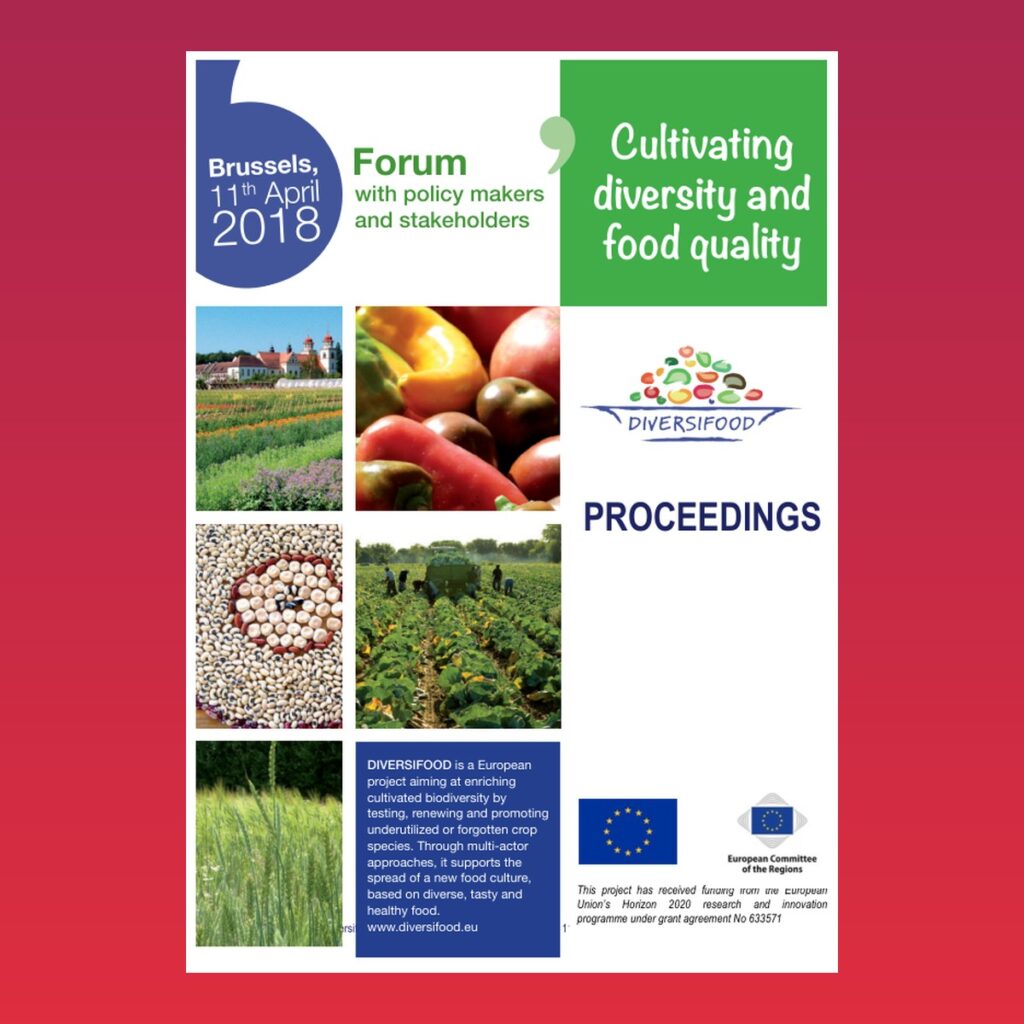
This toolkit presents building blocks to design and implement multi-actor research and participatory plant breeding projects aimed at embedding agrobiodiversity in food systems. Produced from the Diversifood project experience, it explains the concept and rationale of multi-actor research and identifies practical prerequisites: common will and vocabulary, facilitation, trust, transparency, allocation of time and resources, and appropriate distribution of tasks. The toolkit documents concrete Diversifood cases (e.g. emmer, einkorn, rivet wheat, tomato, maize) and outlines methods and tools used across projects: on-farm and on-station trials, germplasm multiplication, organoleptic and nutritional testing, molecular analyses, statistical approaches, databases (SHiNeMa), and stakeholder engagement (farmers, breeders, processors, bakers, consumers). It emphasises iterative mutual learning, empowerment of practitioners, social impacts, and the need to address intellectual property and governance early in the process. The document notes EU Horizon 2020 funding and aims to support multi-actor approaches for organic and low-input agriculture.

Key topics: multi-actor research, participatory plant breeding, agrobiodiversity, on-farm trials, community-based breeding, seed diversity, Horizon 2020

May 2026
No event found!
Load More