The Seed Knowledge Hub was built to keep the answers in one place. It is an open online repository hosted on the EC-LLD website, developed within Seeds ofGrowth, an Erasmus+ small-scale partnership in adult education (KA210), coordinated bySemínkovna (Czech Republic) with EC-LLD and SEED Luxembourg as partners.
The Hub brings together guides, technical manuals, case studies and policy materials on seed saving and cultivated diversity. What was included into it was decided on the basis of a capacity gap analysis that reached 868 people across Europe and collected 140 responses from seed savers, community seed bank managers and seed librarians.
The collection now holds over 80 resources and its growing thanks to the contributions of EC-LLD Members and the broader community. In the Seed Knowledge Hub you can also find the material from the LLD forums. The Hub grows with what the community puts into it. If your organisation has produced a guide, a manual, a template, a study or a policy briefing that others could use, write to info@liberatediversity.org and we will add it. Material in any European language is welcome.

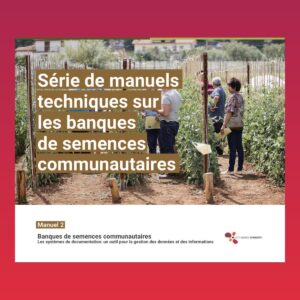
Guide pratique pour concevoir et gérer des systèmes de documentation (formulaires, descripteurs, bases de données, échanges) destinés aux banques de semences communautaires.
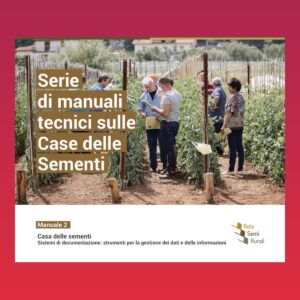
Practical manual on designing and managing documentation systems for Community Seed Banks, covering descriptors, forms, databases, data sharing, software, procedures and a Pro Specie Rara case study.
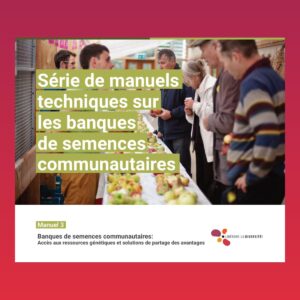
Manuel 3 (DYNAVERSITY) sur l’accès aux ressources génétiques et le partage des avantages pour banques de semences communautaires, couvrant CDB, Nagoya, TIRPAA, cadre européen, scénarios pratiques et outils (ATTM/SMTA).
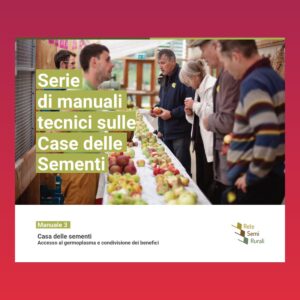
Manuale che spiega il quadro internazionale e europeo su accesso al germoplasma e condivisione dei benefici, con scenari pratici e indicazioni per Case delle Sementi in Europa.
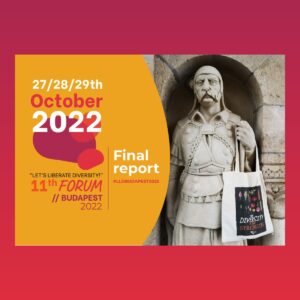
Final report of the 11th Let’s Liberate Diversity! Forum (Budapest, 2022) documenting workshops, outcomes and resources on seeds, agrobiodiversity, EU seed policy, patents, participatory breeding and community seed systems.
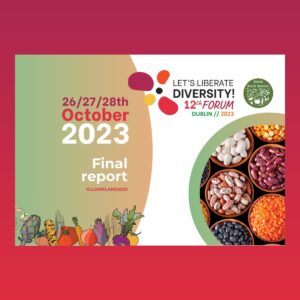
Final report of the 12th LLD Forum (Oct 2023, Dublin) summarising workshops, policy debates (EU seed marketing reform, new GMOs), Farmers’ Rights, community seed initiatives, breeding and seed quality sessions.
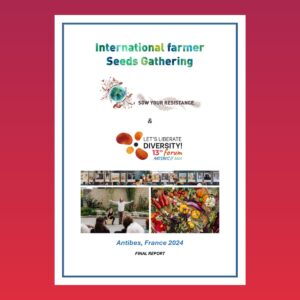
Final report of the 2024 International Farmers’ Seed Meetings (Antibes) documenting programme, participants, workshops, international exchanges and outcomes to support farmers’ seeds and cultivated biodiversity.
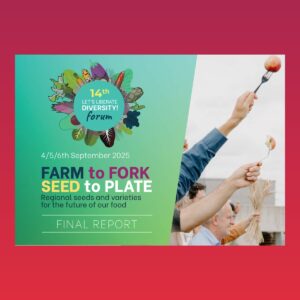
Final report of the 14th Let’s Liberate Diversity! Forum (4–6 Sep 2025, Luxembourg): 123 participants discussed EU seed law reform, UNDROP, patents, NGTs, participatory breeding, seed health, community seed networks and next steps for advocacy and practice.
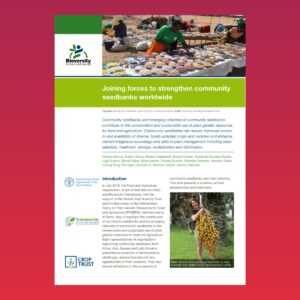
Summary of FAO/Bioversity events (July 2018) on community seedbanks: roles, country examples, lessons and recommendations for legal recognition, technical support, networking and seed-quality improvements.
Showing 76-84 of 84 results
- « Previous
- 1
- …
- 4
- 5
- 6
The Seed Knowledge Hub has been developed within the context of the Erasmus+ project Seeds of Growth: Strengthening Community Seed Banks and Sustainable Seed-Saving Practices in Europe (Project ID: KA210-ADU-1727BE52)

Funded by the European Union. Views and opinions expressed are those of the author(s) only and do not necessarily reflect those of the European Union or the Dům zahraniční spolupráce (DZS). Neither the European Union nor the granting authority can be held responsible for them.