Let’s Liberate Diversity! News

EU reform on seed marketing regulation from the perspective of organic breeders

LiveSeeding policy brief

This policy brief, produced within the LiveSeeding project and published by FiBL-Europe (April 2024, adjusted September 2024), examines the proposed EU Plant Reproductive Material (PRM) marketing regulation from the perspective of organic breeders and stakeholders. It assesses implications for Organic Varieties (OV), Organic Heterogeneous Material (OHM), conservation/amateur/diversity varieties, and proposed changes to testing and registration (DUS and the proposed Value for Sustainable Cultivation and Use — VSCU). The brief recommends keeping the Organic Regulation (2018/848) unchanged; preserving current access to OHM for all crop species and ensuring notification remains free of charge; promoting adjusted DUS and VCU/VSCU protocols conducted under organic or other sustainable cultivation systems; keeping VSCU optional for agricultural crops and not extending mandatory VSCU to vegetables and fruits; supporting frugal, decentralized post-registration on-farm testing networks; registering diversity varieties with low administrative burden and without geographic or packaging restrictions; prohibiting patented PRM and use of genetic engineering/new genomic techniques (NGTs) for OV, OHM and diversity varieties; ensuring transparency of breeding techniques and cultivar types; and involving organic stakeholders in delegated and implementing acts while reducing administrative burdens. The brief calls for public funding for voluntary testing and a multi-actor approach to harmonize registration and testing across Member States to support organic breeding, agrobiodiversity and the EU Green Deal targets.

Key topics: EU seed marketing, organic varieties, organic heterogeneous material (OHM), VSCU testing, DUS testing, patents and NGTs, seed policy

Capacity Building on European Seed Policy and Legislation

DiverSeedPaths report (capacity-building recap of online training session on the proposed PRM regulation, 17–18 October 2024)

This DiverSeedPaths capacity-building report (edited by Gabriele Maneo, ECLLD!) summarises an online training held 17–18 October 2024 by Fulya Batur (Kybele) and other EC-LLD! members provides a concise guide to EU seed policy and the proposed Plant Reproductive Material (PRM) marketing reform. It explains the roles of the European Commission, European Parliament and Council and the Ordinary Legislative Procedure; outlines EU legislative instruments (regulations, directives, decisions, recommendations); and describes the regulatory framework for PRM (seed quality, variety registration, plant health, genetic diversity). The report tracks the PRM marketing reform process (proposal 2023/0227 (COD)), summarises positions from the Commission, Parliament and Council, and presents an analysis from a seed diversity perspective drawing on ARCHE NOAH and the “Raise Our Forks” campaign. Key topics include conservation of locally adapted varieties, farmers’ rights to use and exchange seed, access for regional seed producers, sustainability labelling concerns, and transparency/misappropriation risks. The final chapter offers practical advocacy actions (petitioning, outreach to agriculture ministries, petition handovers, interviews with small seed producers, and Council-focused strategies). Partner organisations and contact emails are listed; the project is co-funded by the Erasmus+ programme and implemented by Aegilops, ECLLD!, and Réseau Semences Paysannes (RSP).

Key topics: EU seed marketing reform, PRM regulation, seed diversity, farmers’ rights, advocacy, Ordinary Legislative Procedure, community seed systems

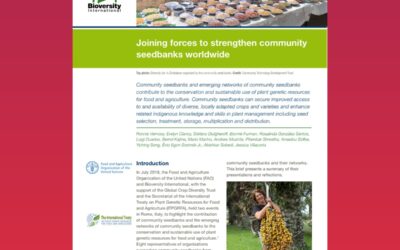
Protocol for Collaboration between the National Genebank and Community Seed Banks

ISSD Africa No. 2021-02

This protocol provides a generic framework to structure, monitor and evaluate collaboration between national genebanks and community seed banks (CSBs). Developed by CTDT, SSN, NARO-PGRC, WCDI-WUR and the Alliance with ISSD Africa, the document defines the functions of national genebanks and CSBs, sets objectives for joint work (including capacity strengthening, participatory breeding and exchange of germplasm), and outlines scope, principles and practical rules for collaboration. Key elements include recognition of farmers’ ownership of seed, the principle of Prior Informed Consent for seed access and exchanges, promotion of resilient and integrated seed systems, support for documentation and knowledge exchange, and alignment with national policies. The protocol lists possible joint activities (seed multiplication, documentation, reintroduction of lost varieties, seed fairs, training, and participatory crop improvement), provisions for compliance, and mechanisms for monitoring and review. A placeholder for an effective date and signature lines are included. Financial supporters and contributing organisations are acknowledged.

Key topics: community seed banks, national genebank, seed governance, prior informed consent, conservation, seed exchange, participatory breeding

European Router Database: centralised platform for suppliers of organic plant reproductive material (PRM)

LiveSeeding (seeds4organic.eu)

This practice abstract describes the European Router Database, a centralised platform designed to help suppliers of organic plant reproductive material (PRM) place and manage their offers across multiple EU national organic PRM databases. Context is provided by EU Regulation 2018/848, which requires each Member State to host a national database; cross-border suppliers otherwise face 27 different systems in different formats and languages. The Router Database enables suppliers to maintain a single account, provides translations into all official EU languages, and supports direct communication with national authorities. Integration via APIs automates the transfer of offers to national databases (12 APIs are currently operational); where APIs are not available, authorities can download offers manually. The platform also functions as a central repository for stakeholder information and is free to use for both suppliers and authorities. The abstract includes five practical steps for suppliers to register and post offers (visit www.seeds4organic.eu, create an account, verify certification, select countries, place and keep offers updated). Author and contact details are given (Kaja Gutzen, FiBL-DE; kaja.gutzen@fibl.org). The work is linked to the LiveSeeding project and notes funding from the European Union, the Swiss State Secretariat for Education, Research and Innovation (SERI), and UK Research and Innovation (UKRI).

Key topics: organic seed, plant reproductive material, seed databases, cross-border supply, APIs, seed access, seeds4organic

PRACTICE ABSTRACT NO.3 Simple, non-destructive measurement of equilibrium Relative Humidity to evaluate seed moisture levels using a hygrometer

LiveSeeding project (Horizon Innovation Actions 2022-2026)

This practice abstract describes a simple, non-destructive method to evaluate seed moisture by measuring equilibrium relative humidity (eRH) with a hygrometer. Seeds are placed in an airtight container with a hygrometer until the air reaches a stable relative humidity that reflects the moisture level of the non-oil fraction of seeds. An eRH of about 30% is recommended for optimal seed conservation; values above 35% indicate further drying is needed. The method is faster and non-destructive compared with oven-drying to measure moisture content and is independent of seed oil content. Practical protocol steps, notes on hygrometer accuracy (±2%), temperature dependence, and sampling considerations are provided. Additional tools and background are referenced, including a LiveSeeding Practical Guide, the Seed Information Database (SID) calculator, and a Drying Beads supplier tool. Contact and project information are included for further guidance.

Key topics: seed moisture, equilibrium relative humidity, seed storage, hygrometer, seed drying, on-farm seed conservation, LiveSeeding

PRACTICE ABSTRACT NO.5 DIY Hot water treatment for sanitazion of vegetable seeds

LiveSeeding: Organic seed and plant breeding to accelerate sustainable and diverse food systems in Europe. Horizon Innovation Actions 2022 – 2026.

This practice abstract provides a do-it-yourself protocol for hot water treatment (HWT) to sanitize vegetable seeds and reduce or eliminate seed-borne bacterial and fungal pathogens. It presents the rationale — using controlled heat and exposure time to deactivate pathogens while minimizing seed damage — and highlights HWT as a cost-effective, environmentally sustainable alternative to chemical seed treatments, particularly suited to small seed batches and organic production. Materials and equipment are listed (mesh bags/stockings, thermometer, heating device, timer, cold water, paper towels), and step-by-step procedures are given: prepare seed bags, heat water to the target temperature, submerge seeds for the recommended time, cool in cold water, and dry. Species-specific temperature/time recommendations are provided (examples: corn salad/carrot/celery 50°C/30min or 53°C/10min; brassicas/onions/radishes 50°C/20min or 53°C/10min; lettuce 50°C/5–10min; beetroot 53°C/30min or 50°C/10min). The abstract warns that heat-sensitive seeds (e.g., beans and peas) require special care and seed-specific protocols to avoid reduced germination. A reference link for more details is given (https://orgprints.org/id/eprint/53533/1/HotWaterTreatment_BSAG.pdf) and contact details for the author are provided.

Key topics: hot water treatment, seed sanitation, seed-borne pathogens, vegetable seeds, organic seed, seed saving

PRACTICE ABSTRACT NO.4 Enhancing Organic Variety Development with SeedLinked: A Collaborative Digital Approach

Practice Abstract No.4, LiveSeeding (Innovation Actions 2022 – 2026)

This practice abstract describes the SeedLinked digital platform as a collaborative tool to support participatory variety evaluation and on-farm cultivar testing for organic variety development. It identifies common challenges of traditional trial methods—time requirements, inconsistent approaches, language barriers, and data protection concerns—and presents SeedLinked’s web and mobile apps as a solution for standardized data collection, analysis and sharing. The platform supports multiple languages and GDPR compliance, and offers features such as real-time mobile data entry and image tagging. Recommendations include using SeedLinked for trial management, engaging with the platform’s webinars and tutorials, providing user feedback to improve European organic variety evaluation, and leveraging mobile app functions to streamline fieldwork. The abstract references practical materials and case studies, including a Horizon case study on a salsify trial with ProSpecieRara, and lists project contacts, social media channels, and funders (European Union, SERI, UKRI).

Key topics: participatory variety evaluation, on-farm testing, digital tools, SeedLinked, plant breeding, agrobiodiversity, data management, GDPR

IntercropVALUES and Leguminose at the EU Parliament

Our colleagues at Iniciativas Innovadoras (ESP) have invited us to the following event:

What

IntercropVALUES and our sister project Leguminose will be at the EU Parliament in Brussels. MEP Cristina Guarda (GREENS) is hosting an event that will explore how EU policies, especially the next CAP, can better boost diversification, notably intercropping.


When

Wednesday, 6th of May 2026. 10:00-12:00 (Brussels, CEST)


Who

Policymakers, farmers, researchers, and agri-food stakeholders will be present in the room with a limited number (35).

But…

Everyone interested is invited to join the event online.

REGISTER HERE: https://forms.gle/aGiMTrZX6N5wdAEe7


LiveSeeding Summer School 2026 – Register now!

Pre-registration for the LiveSeeding Summer School 2026 is now open!

What is it?

This 5-day summer school focuses on Organic Plant Breeding and brings together breeders, researchers, students, advisors, and farmers to explore innovative and participatory approaches. Through a combination of lectures, hands-on activities, and on-farm experiences, you will gain practical skills to work in sustainable seed systems.

Dates, location and participation

·       Dates: 13–17 July 2026

·       Location: Universitat Politècnica de València, València, Spain

·       Possibility for students to get 3 ECTS

·       Participation fee: 100 EUR

·       Maximum 30 participants

·       Six scholarships of 500 EUR will be awarded by ECO-PB (see pre-registration link for details)


Are you interested? (YES!)

 General info: https://liveseeding.eu/trainings-summer-school/

Full Program and Logistics info:  https://liveseeding.eu/liveseeding-summer-school-2026-registrations-are-open/

Pre- Registrations at this link: https://survey.fibl.org/index.php/454332?lang=en are open until 8 May 2026.  Applicants will be informed about the outcome of the selection process by the end of May.

This is your opportunity to deepen your knowledge and contribute to the future of resilient and sustainable seed systems.


No event found!