Let’s Liberate Diversity! News
Seed Markets, Agroecology, and the Right to Food
The new seed brochure Seed Markets, Agroecology, and the Right to Food – by Brot fuer die Welt and HEKS/EPER provides insights from an advocacy journey about the EU Seed Marketing Reform. The brochure addresses the link between seed laws, human rights, and...
What is organic heterogeneous material (OHM) and how can it be notified?
Practice Abstract No.2 (LiveSeeding project)
This practice abstract explains what Organic Heterogeneous Material (OHM) is and how it can be notified under the EU Organic Regulation (EU) 2018/848. OHM describes plant material of a species that shares key phenotypic traits while retaining high genetic and phenotypic diversity, dynamic evolution and local adaptation—features that make standard DUS (distinctness, uniformity and stability) protocols inapplicable. OHM is neither a conventional variety nor a mixture of varieties and therefore is not entered in the variety register; instead it can be placed on the market through a simpler, faster and cheaper notification procedure available to organic operators. The brief highlights that many farmers are not yet informed about OHM and its notification route, which limits uptake. It recommends promoting the simplified notification to breeders, farmers and seed producers to support marketing, foster agrobiodiversity and improve resilience to climate change. The document lists information required for notification to competent national authorities (applicant contact details; species and denomination; description of parental material, breeding methods, main agronomic and phenotypic properties and test results; applicant declaration of truthfulness; and a representative sample) and notes formal submission requirements (registered letter or other accepted channel with confirmation of delivery). The abstract also points to related resources including webinars and a booklet and provides author contact details and project/funding attribution to the LiveSeeding Horizon Innovation Actions (2022–2026).
Key topics: organic heterogeneous material, OHM, EU Organic Regulation 2018/848, seed marketing, notification procedure, agrobiodiversity, participatory breeding
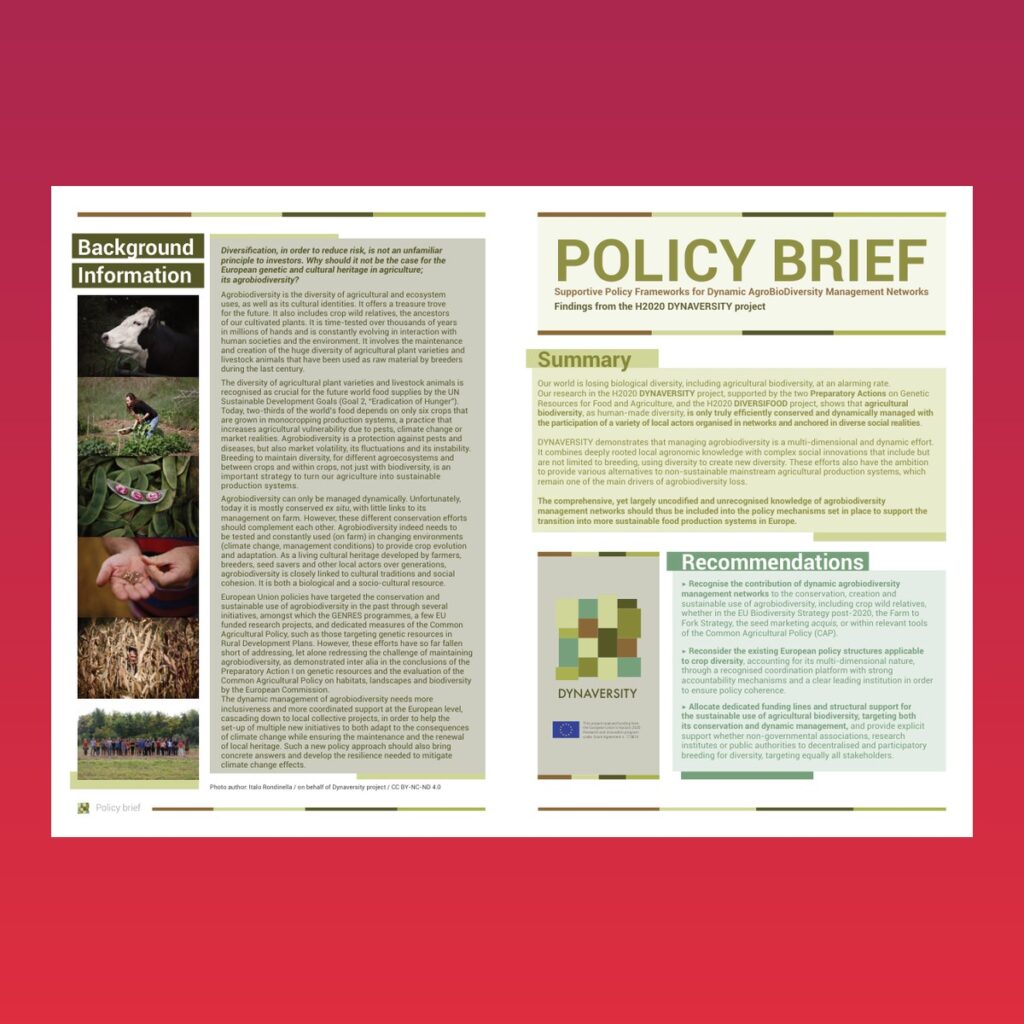
Supporting seed diversity for resilient EU agriculture: A policy perspective
UNEP-WCMC Policy Perspective (PLANET4B project brief)
This policy brief, produced by UNEP-WCMC in collaboration with the Environmental Social Science Research Group under the PLANET4B project, analyses how EU seed policy can better support seed diversity and resilient agriculture. It focuses on the proposed Plant Reproductive Material Regulation (PRM, COM(2023)414) and related EU instruments (CAP, Organic Regulation) and outlines core challenges where current rules favour uniform commercial varieties and exclude conservation, farmer-bred and community-saved seed. The brief synthesises literature review, expert interviews, workshops and policy analysis (with empirical work focused on Hungary) to present six interconnected policy options: (1) enable proportionate seed rules (eg. exempt conservation/non-commercial and allow small-quantity local sales without catalogue listing; consider a nano-enterprise threshold such as < EUR 100,000 annual revenue); (2) recognise and protect grassroots custodians and farmers’ rights, including flexible quality standards and checks to protect traditional knowledge; (3) strengthen collaboration between formal and informal seed systems through participatory research and fair compensation; (4) redirect CAP and research funding to support participatory breeding, on-farm dynamic management and community seed banks, including result-based payments and conservation contracts; (5) foster systems of care and farmer autonomy via PRM routes for small operators and CAP measures supporting community-based approaches; and (6) support interoperable, multilingual knowledge platforms and regional seed networks, and accept platform records as proportionate evidence in PRM processes. The brief argues these measures would align seed policy with biodiversity and climate objectives, preserve agricultural heritage and enhance resilience across EU food systems.
Key topics: PRM, EU seed policy, agrobiodiversity, community seed banks, farmers’ rights, CAP, participatory breeding, knowledge platforms
Right to Food Initiative accepted by the EU Commission!
👉 Explore the official ECI page
👉 Find your language version on Good Food For All’s website (with more being added)
- Spread the word: forward this email, share our posts, tell your networks.
- Connect us to local allies: NGOs, unions, activists, municipal governments.
- Volunteer: help us translate, coordinate, or organize national meetings.
- Fund this effort: we are still building the resources needed for a truly pan-European push.
No one should go hungry.
No one should be left out.
Food is a right — not a commodity.
New Agroecology Digest, June 2025
The June 2025 edition of the FAO’s Agroecology Knowledge Hub’s journal has been published.
This month’s issue explores the urgent need to transition food systems away from fossil fuels, highlighting pathways toward energy-smart, agroecological alternatives through timely reports, thought-provoking webinars, and the “Fuel to Fork” podcast from IPES-Food.
Also in this issue:
- Stories from the ground—from community-led trainings in Asia to women’s leadership in Africa
- New research and policy updates on climate resilience, sustainable inputs, and farmer networks
- Fresh multimedia—from rice-duck farming video to agroecology podcasts in action
You can find a copy of the journal attached to this post. Enjoy the read!
Defend farmers’ seed rights – reach out to EU lawmakers!
EU Commission’s PRM law – a threat to seed diversity and sovereignty
The European Commission’s proposed EU law of Production and Marketing of Plant Reproductive Material is a threat to small seed producers, and to the conservation of seed diversity.
If the proposed seed law is passed, the effects of small seed producers and fruit tree nurseries across the EU will be devastating. This will have important consequences for farming and agriculture in the EU as well as agrobiodiversity, as these producers and nurseries offer a greater diversity of crops and varieties than large companies.
For more information, read more ARCHE NOAH’s recent report here: https://www.arche-noah.at/media/bureaucracy_against_biodiversity_report_may_2025_3.pdf
ARCHE NOAH Report: Bureaucracy against biodiversity
EU Agriculture Ministers meeting – reach out to your minister
The European Parliament has not yet endorsed the EC’s proposed law. On 23 and 24 June EU agriculture ministers will be meeting to discuss the proposed law. Reach out to your country’s minister and ask them to speak up for farmers’ rights and biodiversity.
- Please reach out to your minister to ask to speak up for free conservation work without seed
A leaked version of the Polish government’s position on the proposed seed law would ban farmers from informal seed exchanges.
marketing restrictions. You can use ARCHE NOAH’s briefing on good practices in the current seed marketing laws in the different EU member states when it comes to exempting conservation work from the seed marketing rules. You can the briefing attached in this post here: Good practice example for Agriculture Ministers
- Please continue to reach out to the responsible civil servants and ask them to protect conservation work from overregulation. Mention that all transfers for the aim of conservation should be put outside the scope, as many different actors are needed for successful conservation work next to conservation organisations (farmers, seed libraries, schools, individual seed savers/producers, …)
- Raise media awareness! Share this post and ARCHE NOAH’s ‘Raise Our Forks’ campaign on your social media and networks, and encourage conversations.
“RAISE OUR FORKS – FOR DIVERSITY!”
Support ARCHE NOAH’s campaign calling on EU lawmakers to protect farmers’ rights to keep, use and exchange seed material and defend seed diversity in Europe. Read and sign their petition here: https://mitmachen.arche-noah.at/en/raise-our-forks
Support ARCHE NOAH’s ‘Raise our forks for diversity’ petition. (Image credit: Arche Noah)
Study on Open Source Seed models
Our colleagues at Rete Semi Rurali (RSR) have shared with us a research article for which Riccardo Bocci of RSR is one of the authors.
The authors analyse the strategies of different Open Source Seed models – that is, initiatives that apply open source and copyleft principles to seed systems – to face the current legal and financial paradigms.
The findings show that Open Source Seed models operate in three dimensions:
- Geographical dimension, by connecting local and international efforts to enhance cultivated diversity and seed rights.
- Temporal dimension, by acting now, within the current legal context, while contributing to the long term transformation of seed governance.
- Virtual dimension, through its capacity to be applied in both physical and digital realms.
You can find the reading attached to this post. Enjoy!!
Granollers Symposium: resources and next steps
Dear LiveSeeding partners,
We’re delighted to share with you some audiovisual materials of the Granollers Symposium “Fostering Cultivated Biodiversity through Local Food Policies”:
🎞️ [Audiovisual Summary and Interviews]
📸 [Photo Gallery]
Despite the media attention being dominated by the national power blackout, we managed to publish several news articles covering the event — we invite you to take a look and share them:
📰 [Link to news articles]
You can also revisit the presentations shared during the Symposium here:
📂 [Link to presentations]
Looking ahead, we’re thrilled to announce that the Granollers Manifesto will be presented on October 16 at the Milan Urban Food Policy Pact Global Forum.
See here more information of the session. We would be delighted to see many of you there!
Finally, we’re finalizing translations of the Granollers Manifesto into several languages, and we’ll be sending them soon — together with the Good Practices Manual, created to showcase the power of municipal food policies in integrating cultivated biodiversity. 🌾🏛️
Let’s keep the Granollers spirit alive and continue building bridges for cultivated biodiversity and local food policies across Europe
Inf’OGM Podcast on GMOs and Biotech
Inf’OGM has recently the publication on its website of a serie of podcasts reporting on investigations into little-known biotechnologies. These podcasts will explore the links and promises between GMOs and biotech on the one hand, and climate change, agrofuels, carbon finance, patents, livestock farming, synthetic meat, vector-borne diseases, bioethics and transhumanism on the other hand.
Feel free to listen if you do speak french and / or spread this to anyone who may be interested.
You can find the first episode here: https://infogm.org/omg-decodons-les-biotech/un-mammouth-2-0-pour-sauver-le-climat/