5 th Let’s Cultivate Diversity!
REGISTRATION ARE ALSO OPEN!
The European Grain Festival 2026 in Denmark combines parallel sessions of baking workshops, cooking demos, tastings, field demonstrations, poster sessions and lectures. You will meet and network with experienced bakers, farmers, chefs, processors, breeders and researchers from all over Europe.
—If you aim to produce quality cereal and cereal based food, this is the place to be.
At the heart of the festival you will find a demonstration field displaying hundreds of diverse grain varieties from all over Europe.
USE IT or LOSE IT
The European Coordination Let’s Liberate Diversity! (ECLLD) is an international nonprofit organization dedicated to the dynamic management of plant genetic resources for food and agriculture.
Our core belief is that the diversification of our food systems can be achieved through the collaborative efforts of various stakeholders involved in cultivated biodiversity.
The Coordination boasts a robust network of 22 members with a network of 170 national organizations operating across 21 European countries with a membership base exceeding 35,000.
In collaboration with approximately 15,000 farmers, we actively engage in the conservation and management of around 40,000 plant varieties.
We want to bring diversity back in our food system!
Countries across all the Europan Region
Staff and volunteers
Organisations part of the network
Varietes maintend and managed by the network
Individual Members
Farmers and gardeners involved in dynamic management of cultivated biodiversity

What we do
As an influential platform, EC-LLD! serves as a unique space for facilitating the exchange of practices and information among farmers, seed savers, NGO members, and emerging small enterprises, fostering local actions on agrobiodiversity and promoting participatory dialogues.
Our proven expertise extends to our participation in projects funded by Horizon Europe, Erasmus+ and Horizon 2020. Furthermore, we have established successful collaborations with a diverse range of foundations and academic institutions.
Our work span across the 3 following areas
policy
Capacity building and knowledge sharing regarding agrobiodiversity, seed policies and legislastion.
policy
Capacity building and knowledge sharing regarding agrobiodiversity, seed policies and legislastion.
Communities seed banks
Training, support and management across Europe.
Communities seed banks
Training, support and management across Europe.
Communities
Facilitating peer to peer exchange of practices and information between different actors.
Communities
Facilitating peer to peer exchange of practices and information between different actors.
NEWS
“Raise our Forks” Update
“Raise our Forks!” Petition
The proposed new EU regulation on the production and marketing of plant reproductive material, presented by the European Commission in July 2023, and the current state of negotiations in the Council, threaten the conservation and circulation of crop diversity. It disregards the right of farmers and gardeners to harvest, use, exchange, and sell their own seeds, a right enshrined in international law. This is unacceptable.
The petition calls on the European Parliament and the Council to adopt legislation that enables the free circulation of diverse seeds, enhances biodiversity, respects farmers’ rights, and lays the foundation for a sustainable, resilient, and diverse food system.
Update on the petition
What to do next
Read the latest LiveSeeding Policy Brief
LiveSeeding has published a policy brief on the definition of organic plant breeding for registration of organic varieties suitable for organic production.
The organic sector needs to access a broad genetic base to develop high-quality cultivars, varieties and populations. Varieties can be develop through different breeding strategies, but the definitions and details of these strategies are not always clear.
Read here: LS Policy Brief September 2025
Key Policy Recommendations
- Organic farmers need access to a large portfolio of cultivar types that are well-adapted and suitable for organic conditions and diverse local contexts. Suitable varieties for the organic sector can be developed through different breeding strategies, such as “conventional plant breeding”, “breeding for organic”
and “organic plant breeding”. - “Organic Varieties suitable for organic production” (OV), as defined in the Organic Regulation (EU) 2018/848, may have higher phenotypic or genetic diversity than common varieties. The current adapted protocols for variety registration created by Implementing Directives (EU) 2022/1647 & 2022/1648 [1st July 2023 – 31st Dec 2030] must be perpetuated and expanded to all species to facilitate OV registration and integrated in the new EU Plant Reproductive Material (PRM) Regulation.
- The possibility to notify Organic Heterogeneous Material (OHM), which by definition does not qualify as a plant variety, must be ensured for all species across EU Member States.
- Adopting a clear, consistent definition of organic plant breeding is essential to distinguish it from other breeding strategies. This will help ensure the unambiguous implementation of Implementing directives (EU) 2022/1647 and 2022/1648, which concerns the registration of “Organic Varieties suitable for organic production” (OV) derived from organic breeding activities (EU 2018/848, Annex II 1.8.4).
- The definition shall recognise organic plant breeding as an approach conducted exclusively under organic farming conditions, producing cultivars well-suited for organic farming systems. By respecting natural crossing barriers and fostering manifold interactions between plants and living soil, this approach is fully in line with the general organic principles and makes a substantial contribution to expanding the organic sector and facilitating the broader transition towards sustainable food systems.
Study on Open Source Seed models
Our colleagues at Rete Semi Rurali (RSR) have shared with us a research article for which Riccardo Bocci of RSR is one of the authors.
The authors analyse the strategies of different Open Source Seed models – that is, initiatives that apply open source and copyleft principles to seed systems – to face the current legal and financial paradigms.
The findings show that Open Source Seed models operate in three dimensions:
- Geographical dimension, by connecting local and international efforts to enhance cultivated diversity and seed rights.
- Temporal dimension, by acting now, within the current legal context, while contributing to the long term transformation of seed governance.
- Virtual dimension, through its capacity to be applied in both physical and digital realms.
You can find the reading attached to this post. Enjoy!!
Scandalous patent granted on tomatoes
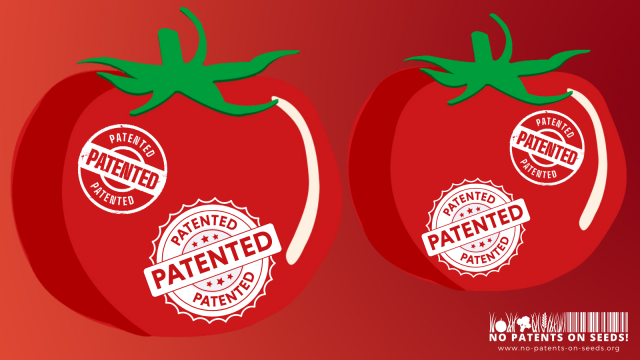
Dutch company given patent on GMO tomato
Patent EP3911147 held by the Dutch company, Enza Zaden, claims genes conferring resistance to the Tomato Brown Rugose Fruit Virus (ToBRFV). This virus poses a major threat to tomato cultivation. The claimed genes were discovered in a wild tomato species (Solanum habrochaites) that originates from Peru and Ecuador, and is considered one of the most important resources for genetic diversity in tomato breeding. The patent was granted by the European Patent Office (EPO) in July 2025.
The virus-resistant plants were crossed with tomatoes currently marketed in Europe (Solanum lycopersicum), thereby transferring the resistance. The European Patent Convention (EPC) prohibits patents on processes and products derived from crossing and selection. Nevertheless, this patent claims all breeding with the resistance genes for traditional breeding. If such patents are granted, natural genetic resources detected in wild or cultivated plants could be reclassified as technical inventions, thus making freedom to operate in traditional breeding impossible.
“The increasing threat of monopolization similarly affects gene banks and old regional varieties as well as currently marketed varieties on the market. These can be screened for naturally occurring genes whose further use may be blocked by a patent or be made subject to licensing agreements.” says Dagmar Urban for ARCHE NOAH.
Europe only allows genetically engineered plants to be patented. European legislators have enacted several legal provisions to prevent conventional plant breeding from being patented, most recently Rule 28(2) for the interpretation of the EPC. However, patent practices at the EPO undermine these provisions.
“This case is an alarming sign that the EPO is violating the intention of the legislator to prevent patents on plants and plant material used in conventional breeding. Furthermore, the patent shows that company activities also include biopiracy.” Johanna Eckhardt says for No Patents on Seeds!.
Resisting patents on traditional breeding and crossing
Against this backdrop, No Patents on Seeds! recommends that the EU launch an initiative to definitively clarify the limits of patentability in law. This could be decided within the framework and context of the current negotiations on new genomic technologies (NGTs).
No Patents on Seeds! recently joined with other organizations and breeding companies to file an opposition to another patent on tomatoes (EP 3629711). Legally, however, the new patent described above must be assessed differently. The older patent was already filed before Rule 28(2) officially came into force. The Enza Zaden patent is the first to be filed and granted after Rule 28(2) came into force claiming natural genes for crossing and selection.
Further information
– Tomato patents (ToBRF-Virus): https://www.no-patents-on-seeds.org/en/jordan_virus
– The Enza Zaden patent on the homepage of the EPO:
https://register.epo.org/application?number=EP19880924
Share this news!
You can share our posts about this press release on Facebook and X or share the direct link to this press release: https://www.no-patents-on-seeds.org/en/enza_zaden
Granollers Symposium: resources and next steps
Dear LiveSeeding partners,
We’re delighted to share with you some audiovisual materials of the Granollers Symposium “Fostering Cultivated Biodiversity through Local Food Policies”:
🎞️ [Audiovisual Summary and Interviews]
📸 [Photo Gallery]
Despite the media attention being dominated by the national power blackout, we managed to publish several news articles covering the event — we invite you to take a look and share them:
📰 [Link to news articles]
You can also revisit the presentations shared during the Symposium here:
📂 [Link to presentations]
Looking ahead, we’re thrilled to announce that the Granollers Manifesto will be presented on October 16 at the Milan Urban Food Policy Pact Global Forum.
See here more information of the session. We would be delighted to see many of you there!
Finally, we’re finalizing translations of the Granollers Manifesto into several languages, and we’ll be sending them soon — together with the Good Practices Manual, created to showcase the power of municipal food policies in integrating cultivated biodiversity. 🌾🏛️
Let’s keep the Granollers spirit alive and continue building bridges for cultivated biodiversity and local food policies across Europe
Inf’OGM Podcast on GMOs and Biotech
Inf’OGM has recently the publication on its website of a serie of podcasts reporting on investigations into little-known biotechnologies. These podcasts will explore the links and promises between GMOs and biotech on the one hand, and climate change, agrofuels, carbon finance, patents, livestock farming, synthetic meat, vector-borne diseases, bioethics and transhumanism on the other hand.
Feel free to listen if you do speak french and / or spread this to anyone who may be interested.
You can find the first episode here: https://infogm.org/omg-decodons-les-biotech/un-mammouth-2-0-pour-sauver-le-climat/
New Agroecology Digest September 2025
Focus on Pastoralism
This month’s InFocus theme is Rethinking Pastoralism: Tradition and Transformation. Too often overlooked, livestock and pastoral knowledge are vital for resilient food systems and agroecological transitions. From Maasai communities in Kenya organizing for justice, to farmer–pastoralist synergies in Tanzania and Burkina Faso, and Mediterranean innovations linking crops, trees, and livestock—discover how pastoralism is shaping sustainable futures.
In the Germinate! guest column, they feature Colin Anderson from the UVM Institute for Agroecology, who reflects on “Reimagining resilience: Building just and equitable food systems”. Originally published in Rooted Magazine (Issue 3), the article draws on his contribution to the HLPE report “Building Resilient Food Systems” (2025) for the Committee on World Food Security.
Highlights from this month’s Digest include:
🌱Voices from the Ground: Youth-led market gardening in Benin; women restoring land in Senegal; and Kenya’s consumer and policy challenges for agroecology…
📰In the News: Brazil revives pro-farmer policies; Zambia pioneers agroecology radio; Sri Lanka scales natural farming; new debates on AGRA in Africa; and a proposed agroecology bill in the DRC…
🔬From the Research World: Insights on ancestral Mexica farming; urban agroecology in Mozambique; agroecology indicators for East Africa; women farmers’ potential in sub-Saharan Africa; and socio-ecological approaches to restoration…
📑Policy Briefs & Reports: Key findings on Africa–EU research collaboration; farmer-managed seed systems; biofertilisers; agroforestry for resilience; and national agroecology strategies…
🎥Multimedia & Learning: Inspiring stories—from Sicilian farmers reclaiming land from the Mafia to Kenyan seed savers—plus resources on regenerative farming across Europe…
📅 Upcoming Events: The Agroecology Europe Forum 2025 (Malmö, Sweden), the International Forum on Agroecosystem Living Labs, and the launch of the FO-RI Capitalization Report
New Feature
In this issue the FAO also introduce a new feature—Partner’s Corner—which shines a spotlight on organizations making a difference. This month, they highlight Access Agriculture, with new videos on alley cropping, pest management, microgreens, and community knowledge centres.
Mapping Actors in Farmers’ Managed Seed Systems Worldwide
Farmers’ seed systems are central to biodiversity, resilience, and food sovereignty. Yet, organisations and networks working in this space often face a common challenge: global and regional seed policy processes are numerous and resource-intensive, making it difficult for many actors to follow and engage consistently.
To address this, a group of organisations came together during the 2024 Let’s Liberate Diversity! Forum in Antibes and launched a new initiative: Strengthening International Farmers’ Seed Networks. The aim is to create a shared space of collaboration, where knowledge can circulate, experiences can be exchanged, and local initiatives can connect with global processes.
The initiative is co-led by the European Coordination Let’s Liberate Diversity! (EC-LLD), Oxfam Novib, IFOAM Seed Platform, Farmers’ Seed Network (China and Kenya), Seed Library Network, and Seeds4All, with contributions from SKI, AFSA, MASIPAG, and many others. Together, these actors are building an informal, inclusive process that continues to gain momentum.
Take Part in the Survey
As a first milestone, we are launching a global survey to map actors involved in farmers’ managed seed systems and cultivated biodiversity. By taking part, you will help make visible the diversity of initiatives across the world, highlight potential synergies, reduce duplication, and lay the foundation for a stronger global community of practice on farmers’ seeds.
Répondre au questionnaire en français
Responder la encuesta en español
About the Survey
-
Duration: 10–15 minutes
-
Languages: English, French and Spanish
-
Participation: Voluntary and anonymous, with the option to stay connected
-
Questions cover profiles of actors, collaboration and policy engagement, knowledge exchange needs, and priorities for collective action.
The results will be compiled and shared with all contributors before the end of 2025, providing the basis for a work plan in 2026 to strengthen international cooperation around farmers’ seed systems.
We encourage you not only to fill in the survey but also to share it widely within your networks, helping to ensure that the diversity of voices and experiences in farmers’ seed systems is captured.
Let’s Liberate Diversity! Forum: a growing community
From September 4–6, Luxembourg hosted the 14th edition of Let’s Liberate Diversity! Forum, which brought together more than 120 participants from over 20 countries across Europe and beyond. Over the course of three days, the Forum featured a rich program with contributions from more than 50 speakers, including farmers, researchers, academics, and representatives of NGOs.
Day 0: Let’s Liberate Diversity! General Assembly
The opening day was dedicated to the General Assembly of the European Coordination Let’s Liberate Diversity! (EC-LLD). Highlights included the adoption of a new statute, the launch of upcoming initiatives on European seed legislation reform, the presentation of new projects and partnerships, and the welcoming of a new member: Polerani, a seed saver organisation from Bulgaria. With this addition, EC-LLD now brings together members from 23 countries.
Day 1: The start of the 14th Let’s Liberate Diversity! Forum! with workshops and a first social dinner
The handover ritual: from LLD 2024 in France to LLD 2025 in Luxembourg.
From the second day onward, the Forum came alive with its symbolic ritual: the handover between the 2024 and 2025 editions. This year, the gesture was marked by the passage of a maize cob from Maxime Schmitt, representing MSPM and host of the 2024 edition, to Frank Adams of SEED Luxembourg, co-organizer of the 2025 Forum. The 2024 French edition, held alongside the “Sème Ta Résistance” event, had welcomed more than 500 participants, you can see the full report of the previous edition here. This year’s program featured 18 workshops, offering a wide range of spaces for exchange and learning. Farmers, researchers, seed savers, activists, and policymakers came together to explore pressing issues such as European legislation, the implications of new genomic techniques (NGTs), and strategies to strengthen seed sovereignty and biodiversity. The workshops combined practical experiences from the field with policy discussions and collective reflections, creating opportunities to share knowledge, build alliances, and set future priorities, including through the launch of a global survey designed to map the ecosystem of actors working on farmers’ seeds. Beyond the workshop sessions, participants also enjoyed moments of conviviality, including a shared social dinner that strengthened connections and celebrated the spirit of the Forum.
Day 2: Morning workshops, tastings, and a diversity market
The second day of the Forum closed in the morning with the workshop sessions and an open circle for sharing outcomes and next steps. In the afternoon, panel tests, tastings, and the diversity market took place. We were honored by the presence of Luxembourg’s Minister of Agriculture, M. Hansen, who took part in the activities and met with producers.
Participants joined guided tastings of local apple varieties from Switzerland and Luxembourg, sampled beers brewed with traditional grains, explored seven varieties of legumes, and enjoyed Gentil Pasta made with local Tuscan cereals—turning theory into a tangible experience of agrobiodiversity. Many of these foods not only help preserve agricultural biodiversity in the fields but are also nutritionally superior. In fact, numerous scientific publications confirm that flours from local grains have beneficial health properties, particularly for people with diabetes. Meanwhile, a lively market featuring more than 25 producers further showcased the richness of Luxembourg’s local and traditional products.
The Workshops were also a key opportunity to disseminate to a wider audience key outcomes of the Horizon Europe project Liveseeding with workshops dedicated to seed quality and health and seed laws.
Legumes agrobiodiversity. Seeds from EVA network within Rete Semi Rurali project
Tasting Gentil Pasta, made from local wheat varieties from Tuscany
Variety development and utilisation strategies of old fruit tree cultivars of Hans-Joachim Bannier
Day 2: Closing the day with the conference ” Patents Vs Biodiversity”
Alongside the workshop discussions, the day celebrated how cultivated biodiversity can reach our plates. A public conference addressed the timely and contested theme of “Patents vs. Biodiversity.”
The event provided a space for dialogue among farmers, legal experts, researchers, and civil society, examining the growing tension between intellectual property regimes and the collective stewardship of seeds and genetic resources. The debate highlighted the risks that restrictive patents pose to farmers’ rights and food sovereignty, while also showcasing avenues for advocacy and collaboration to protect biodiversity as a common good.

Day 3: Field Visits and Goodbyes
The final day of the Forum took participants out into the field, with visits to the hosting Agricultural Technical High School and a local seed company. These encounters added a practical dimension to the discussions.
As the Forum drew to a close, attention turned from the program itself to the spirit that animated it. Beyond the discussions, workshops, and field visits, convivial moments, shared meals, informal exchanges, and celebrations, proved essential for fostering collaborations, building common narratives, and giving new energy to the movement.
©AlexandraBaumgartner
The Let’s Liberate Diversity! Forum has once again confirmed its role as a key gathering for all those engaged with seeds and biodiversity: a space where experiences intersect, connections are strengthened, and new perspectives for the future take shape.
The next edition will take place on 22–24 May 2026 in Scandicci (Florence), hosted by Rete Semi Rurali. We look forward to seeing you there!
LLD Forum
Farmer-Managed Seed Systems in Tanzania: Workshop report
Tanzania Alliance for Biodiversity and SWISSAID deliver workshop
From the 28th to the 30th of August 2025, Tanzania Alliance for Biodiversity organised the workshop “Creating Space for Farmers’ Seeds in Seed Regulations – Capitalizing International Learnings and Identifying Options for Tanzania”. The workshop was attended by 55 participants including Tanzanian Ministry of Agriculture, Members of
Tanzanian Parliament, regional and continental experts, civil society organizations, researchers, and farmer
representatives from 10 African and European countries.
The workshop was very successful, enabling participants to propose a number of options for Farmer-Managed Seed Systems within the legal framework in Tanzania and beyond. It was also an opportunity to unpack the EAC Seed and Plant Variety Bill and to call upon EALA to consider farmers’ rights in the Bill. In addition, participants contributed to the AU Farmer-Managed Seed Systems Bill, making the discussions a true eye-opener on many key issues related to Farmer-Managed Seed Systems.
Key findings
- Farmer-Managed Seed Systems (FMSS) are the backbone of Tanzanian agriculture, providing over 80% of seeds used by farmers and playing a vital role in food security, resilience, and agrobiodiversity, yet remain legally unrecognized and unsupported in the Seed Act of 2003.
- Tanzania’s seed laws lack clear provisions on farmer-managed seeds, creating uncertainty around farmers’ rights to save, exchange, and sell seed. This hinders alignment with international commitments like ITPGRFA and UNDROP.
- Legal recognition of FMSS within the Seed Act and other relevant laws is essential to protect farmers’ rights, enable diversity in seed systems, and promote innovation. Experiences from Ethiopia and India offer proven policy models.
- Inclusive registration systems and alternative quality assurance mechanisms like Participatory Guarantee Systems (PGS) can reduce barriers for farmers and legitimize diverse seed practices while maintaining quality standards tailored to local realities.
- Institutional reforms, including reviving the PGRFA Bill and supporting community seed banks, are critical for long-term, systemic integration of FMSS into national agriculture policy and seed laws hence ensuring Tanzania builds a pluralistic, resilient, and sovereign seed system.
Workshop report and policy brief now available
The revised version of the workshop report is now available here: Creating space for FMSS Workshop Report 2025
A policy brief has also been produced and is available here: POLICY BRIEF CREATING SPACE FOR FMSS 2025
Happy reading!
Seed legislation, seed marketing, advocacy, seed systems, scientific publication, school and seminar, patents
Agrobiodiversity, seed savers, seed networks
Plant breeding, LLD Forum, news from members, news from other organizations
– SEEDS STORIES –
-COMMON CALENDAR –
EC-LLD! General Assembly (for EC-LLD! members only)Field Visits
Official opening of the ForumField Visits
WS1: Seeds, Biodiversity and the Right to Food: The Role of Municipal Food Policies
WS 2: Seeds in Common: Genebanks, Breeding Innovation, and the Future of Democratic Seed Systems
WS 3: On-farm agrobiodiversity in the Balkan region: from preservation to plant population development
Submit an Event
Legal Watch
The legal watch is realised by the French Farmers’ seeds network, Réseau Semences Paysannes. Informations are related to seeds marketing, intellectual property rights, genetic ressources.
It is presented in French.
on EU topics
- Plateforme ACLP, Communiqué du 27 février 2025 - L’ACLP participe à la table ronde sur la propriété intellectuelle et les semences au Salon international de l’agriculture de Paris 2025
- Convention sur la diversité biologique, Communiqué du 24 février 2025, Le Fonds de Cali est lancé en marge de la reprise de la session de la COP16
- OMPI, Communiqué du 5 décembre 2024 - Le Malawi est le premier pays à ratifier le Traité de l’OMPI sur la propriété intellectuelle, les ressources génétiques et les savoirs traditionnels associés
- Confédération suisse, Avis du Conseil fédéral sur le rapport de la CSEC-N relatif à la prolongation du moratoire sur le génie génétique, 29 janvier 2025
- ACLP, Communiqué du 5 février 2025 - L’ACLP organise une session d’information pour les décideurs politiques de l’UE