Let’s Liberate Diversity! News

Diversity of Finnish grains

Bringing diversity to Fields with Heritage Grains

The Diversity to Fields project (2021-2023) at Häme University of Applied Sciences and the Natural Resources Institute Finland is funded by the Finnish Ministry of Agriculture and Forestry. The project seeks solutions for the diversification of grains grown in Finland through the use of heritage grains and old commercial seed varieties.

In this article we get some insights from the project directly from researchers:

More information about the project can be obtained by registering for the project’s English newsletter.

Bringing more seed varieties into cultivation

By using materials from NordGen, the Nordic Genetic Resource Centre, Finland has the opportunity to change the trend that leads to one-sided cultivation. The network for propagation of heritage grains aims to propagate and test varieties that have been preserved for decades in the gene bank. Propagation takes place from a few grams of seed and is propagated so that as many varieties as possible are brought back into cultivation.

The project develops and strengthens the business model for the propagation network that was established in 2017 and has 66 growers (2022) and cultivates a total of 156 landraces or old commercial varieties of arable crops. Of these, 110 are landrace grains, the rest are buckwheat, broad beans, peas and grass plants. In addition, there are landraces and old commercial varieties that have always been preserved in cultivation on farms in Finland.

The combined inputs of propagation growers and field trials

Information about grain propagation is collected annually from members of the network. The project develops guidelines for, among other things, germination, sowing, threshing, drying and sorting. In addition, instructions are given for species-specific protection distances, protection against animals and storage of seed lots.

The project conducts cultivation experiments under ecological cultivation conditions at Häme University of Applied Sciences Mustiala educational and research farm. Ten-variety comparisons are made annually and observations are made during the growing season. Quantitative and qualitative analyses of the crops are also carried out.

The landrace "Rusutjärvi"
The landrace “Rusutjärvi” on HAMK Mustiala’s experimental field in 2021.
This landrace was found among other grains cultivated on field. Photo: Annika Michelson, HAMK

Towards more sustainable food production

Risotto made from Malmgård's einkorn small pearls
Photo: Annika Michelson, HAMK

Traditionally, grain porridge and rye bread have been part of the Finnish dining table. Later, wheat became the dominant cereal in the diet.

There are many opportunities in grain product development. Just as hundreds of different forms of pasta have been developed from wheat in Italy, we can develop a variety of new products from heritage grains. The picture shows a risotto made from Malmgård’s einkorn small pearls, which was awarded the Finnish Ecological Association’s award Organic Product of the Year 2021.

The project develops steps to increase the diversity of Finnish plant production. Increasing the cultivation of heritage grains and old commercial varieties requires an assessment of their usefulness from the point of view of production and further processing. In addition to harvest and quality criteria, usability is related to harvest resilience in different climatic conditions and the nutrient content of the crop.

Landraces can have economic value as special raw materials as food and feed and as part of the companies’ specialization. While genetic diversity and cultural-historical values ​​have so far been particularly emphasized in the cultivation of heritage grains, their continued profitability requires economic viability.

The value chain for heritage grains, from farmers to consumers, is short and there are still challenges to solve, e.g. in the packaging of small seed lots and in the lack of small mills. In addition to branding heritage grains and a general information campaign on their potential, new recipes and product development are needed. The success of heritage grains ultimately lies in the hands of consumers.

A new paper on digital sequence information, cultivated biodiversity and the movement for open source seed systems

4th Industrial Revolution technologies that blur the lines across physical, digital and biological domains have entered seed systems. The digitalisation of seeds’ DNA is generating the unstoppable growth of big data on digital sequence information (DSI).

A new paper titled “From land enclosures to lab enclosures: digital sequence information, cultivated biodiversity and the movement for open source seed systems” analyses the lack of definition and the ongoing legal vacuum for DSI, which aggravates the dematerialisation and fragmentation of seed and other plant genetic resources for food and agriculture, rendering them easier to control under legal, technological, social and logistical enclosures.

The article discusses the different sides of the DSI debate, which involves a wide variety of interwoven arguments ranging from the conception of DSI as human-made, to digital biopiracy and open science. Current DSI developments are identified as part of a wider set of appropriationism and substitutionism trends in an increasingly digitalised food system. The potential of open-source seed as a social movement and governance mechanism across physical and digital spheres is analysed. The article concludes DSI is emerging as a critical juncture for seed movements, revealing how the construction of seed and food sovereignty has inextricably become a digital and technological affair.

Lauren May_Seed Sovereignty in the European Union Research Article

Seed Sovereignty in the European Union

Short biography of the author:

Lauren May is a recent MSc graduate from Maastricht University in the Netherlands. She conducted this research as her Master’s thesis with the ambition to contribute to policy supporting sustainable approaches to agriculture and more just relationships between farmers’ rights, agrobiodiversity management, and intellectual property. Lauren is inspired by agroecological principles, deeply concerned with interconnected social and environmental agricultural sustainability issues, and passionate about how well communicated research can be a powerful medium for change.

Introducing the Context – Agrobiodiversity Management, Intellectual Property Rights, and Seed Sovereignty.

Agrobiodiversity is declining steeply. The number of crop varieties cultivated in Europe has plummeted; between 1903 and 1983, 578 varieties of bean declined to only 32 (Thrupp, 2000). Waning agrobiodiversity represents a permanent loss of culture, history, knowledge, nutrition, and habitat. This erosion is especially concerning in today’s age of climate crisis as agrobiodiversity is essential to create resilient agroecosystems. It promotes pest and disease resistance, encourages healthy soil, provides nutritional variety, and increases agricultural systems’ capacity to cope with extreme weather (Da Vià, 2012; Garnett et al., 2013; Thrupp, 2000).

Since the genesis of agriculture approximately 12,000 years ago, communal seed saving practises have conserved and cultivated agrobiodiversity (Golay & Bessa, 2019; Thompson, 2014). Seed communities, wherein saved seeds are shared, provide farmers with access to trustworthy, genetically diverse, locally adapted seeds allowing them to cultivate resilient, low-input crops which nurture food sovereignty. Seed saving practises are embedded in the culture and knowledge of many rural communities (Golay & Bessa, 2019; Montenegro De Wit, 2017; Frison & Coolsaet, 2018; Singh Decosas, 2010;  Thrupp, 2000). Agrobiodiversity and smallholder agriculture are mutually reinforcing; small-scale, low-input agriculture depends on the resilience that agrobiodiversity fosters and seed saving maintains and creates such biodiversity (Frison & Coolsaet, 2018).

The relationships between rural communities and their seeds have experienced mounting disturbance since the 1970’s when the US and Europe began promoting an intellectual property rights (IPR) regime enabling breeders to possess and commercialise living organisms. Applying IPRs to plants creates a market incentive for innovation in plant breeding.  To fuel this, they prevent rural communities from freely saving, re-sowing, and sharing seeds (Aistara, 2014; Golay & Bessa, 2019; Sievers-Glotzbach et al., 2020). IPRs on plant varieties have globalised through treaties such as the International Union for the Protection of New Varieties of Plants (UPOV) and the World Trade Organisation’s (WTO) Trade-Related Aspects of Intellectual Property Rights (TRIPS) agreement. This despite the resistance of communities and nations in the global South concerned that when seeds are possessed, the foundation of food systems, livelihoods, and cultures is controlled (Ajl, 2021; Golay & Bessa, 2019).

This research investigates two policy cases implementing IPRs on plant varieties: the EU’s Community Plant Variety Right (CPVR) and India’s Protection of Plant Varieties and Farmers’ Rights act (PPVFR) (Fleck & Baldock, 2013; Smith & Jarvis, 2011). The CPVR centralises IPRs on plants in the EU. It recognises its role in protecting the needs of breeders and farmers alongside economic, social, and environmental aspects of sustainability, but its effectiveness in meeting these objectives is debated (Smith & Jarvis, 2011; Golay & Bessa, 2019). Some scholars assert that the CPVR largely meets its goals and satisfies stakeholders, but others claim that it fails to protect human rights, disproportionately protects industry interests, and actively marginalising rural communities (Golay & Bessa, 2019; Smith & Jarvis, 2011). Contrastingly, India’s national policy has been described as a unique first step in rebalancing the distribution of power between breeders and farmers (Brahmi et al., 2004).

Seed sovereignty is a component of food sovereignty which asserts farmers’ right to continue traditional seed saving and hold determination over their community’s genetic resources. It has been used by projects and activist networks sprouting globally in response to globalising and strengthening IPRs (Aistara, 2014; Assadi, 2000; Pearson, 2013). This research emphasises that seed sovereignty is essential to just, resilient agriculture systems able to adapt to climate change (Adhikari, 2014; Golay and Bessa, 2019).

Seed_From-Maize-Seeds-Photograph-by-World-Bank-Photo-Collection-2014
Note. From Maize Seeds [Photograph], by World Bank Photo Collection, 2014, Flickr (https://www.flickr.com/photos/worldbank/14982575134/in/album-72157601433335970/). CC BY-NC-ND 2.0

Literature Review – History and Philosophy Behind Intellectual Property Rights Applied to Plant Varieties.

IPRs originated in the US but were also promoted by Europe (Brandl & Glenna, 2017; McCune, 2018). In 1994, the WTO’s TRIPS agreement set minimum requirements for national IPR law requiring inventions to be patentable with a possible exemption for living organisms and essentially biological processes (Brandl & Glenna, 2017; Kim, 2006; Louwaars et al., 2006; Pearson, 2013; Randeria, 2003). To exclude plant varieties from patenting, states must implement a sui generis system (WTO, n.d.). In 1961, UPOV was created in Europe and now provides a framework to implement sui generis plant variety rights (PVR). A key pillar of UPOV is breeders’ right to access any plant variety for further research (Brandl & Glenna, 2017; Girard, 2015; Visser & De Jong, 2016; Zapiain, 2008). UPOV has evolved towards an increasingly narrow conception of farmers’ rights. In 1991 the farmers’ privilege became optional; member states can choose to permit farmers to save propagating material from their own harvest for use on their own land, or not (Brandl & Glenna, 2017; UPOV, 1991; Montenegro De Wit, 2017; Visser & De Jong, 2016).

IPRs and PVRs use exclusion to commercialise plant varieties. They disrupt the regenerative cycle of seeds through policy prohibiting communal seed management (Brandl & Glenna, 2017; Montenegro De Wit, 2017; Kim, 2006). Commercialisation has altered the relationship between farmers and seeds; seeds once belonged to and represented the rural communities that nurtured them but are now increasingly a product farmers consume at cost (Pearson, 2013; Thompson, 2014). To benefit from IPRs, breeders must produce varieties fulfilling distinctness, uniformity, and stability (DUS) criteria (Sievers-Glotzbach et al., 2020). Most varieties bred in rural communities cannot fulfil DUS criteria as seed saving practises maintain genetic diversity to promote agricultural resilience (Aistara, 2014; Sievers-Glotzbach et al., 2020). The crop improvement industry seeks to amass profit fuelled by excludability and coupled with expensive chemical inputs, but ironically relies upon common global genetic resources derived from agrobiodiversity maintained by communities through seed saving practises (Montenegro De Wit, 2017).

Accumulation by dispossession describes the process of commodifying genetic resources (Montenegro De Wit, 2017). Accumulation refers to collecting genetic material to develop new plant varieties. Dispossession refers to using such material without consulting the community who fostered it and encouraging farmers to replace traditional seeds with modern varieties. Dispossession erodes agrobiodiversity through lack of use (Montenegro De Wit, 2017). Accumulation by dispossession has two major consequences. The first is socio-environmental; agrobiodiversity loss decreases agricultural resilience. This results in food and livelihood insecurity. The second consequence is socio-cultural; replacing traditional seeds and farming practices with modern seeds and high-input agricultural techniques causes knowledge, culture, and identities associated with traditional varieties to be lost (Montenegro De Wit, 2017). Montenegro De Wit (2017) identifies these as the consequences of formal seed systems and argues in favour of informal seed systems. They describe farmers resisting accumulation by dispossession by continuing to use traditional varieties for personal consumption and relegating modern varieties to cash crops.

IPRs allow inventors to lease their inventions to society to gain compensation for their work. When this model is applied to plant varieties it fails to account for the role generations of rural communities have played in maintaining and generating genetic resources (Visser & De Jonge, 2016). In India communities engage in ritualised seed sharing practises called Akti festivals ceremoniously bringing their seeds together, mixing them, and then distributing a share of the diverse seeds to each party (Montenegro De Wit, 2017; Frison & Coolsaet, 2018; Singh Decosas, 2010; Visser & De Jonge, 2016). Rural communities can successfully govern informal seed systems using traditional knowledge, customs, and values like gift giving, reciprocity, and trust based on their shared needs and community bonds (Montenegro De Wit, 2017; Zapiain, 2008). This illustrates the importance of accounting for how PVRs limit rural communities implicating food sovereignty, livelihoods, community cohesion, and adaptive capacity of agricultural systems (Frison & Coolsaet, 2018; Visser & De Jonge, 2016).

In 2000, a Seed Tribunal was held in Karnataka, India giving farmers the opportunity to testify on the crisis of suicides in rural communities (Assadi, 2000). Farmers spoke about the negative consequences of IPRs and resulting domination of agribusinesses. Seed supply had become an issue; corporations made bold claims regarding their varieties’ high yields and resilience. Promises were often not fulfilled despite big investments farmers were encouraged to make in seeds and other inputs (Assadi, 2000). Some farmers saw yield increases, but the environmental degradation and shift away from traditional, locally adapted varieties meant could not be sustained. Farmer struggled in debt cycles characterised by untrustworthy loans taken out to pay for new seeds and inputs followed by desperate measures, including organ sale and suicide, taken to pay off debts. The tribunal led to calls for India to implement policies protecting rural citizens (Assadi, 2000).

The challenges associated with IPRs are not confined to the global South. Negative consequences are also present in the EU, especially where inequality is found, like across the East-West or rural-urban divide. In Latvia outrage emerged from legal action against a couple selling heritage tomato seeds to their gardening club (Aistara (2014). This incident stimulated debate regarding the EU PVR system, the inability of those stewarding heritage varieties and biodiversity to qualify for compensation, and prejudice towards rural life (Aistara, 2014). The EU is not immune to challenges facing small-scale farmers. Industrialisation and the prevalence of large-scale agriculture do not negate the existence of European smallholders, their contribution to food production, or their need for support especially as increasingly recognised sustainable food producers (Ajl, 2021).

According to Vandana Shiva, a prominent activist for seed and food sovereignty, there are two natural laws of the seed. The first says that “seed should give rise to seed” (p.3) which means that seeds should be saved and re-sown (Singh Decosas, 2010). The second law states that “seed is commons” (p.3) meaning that seeds should be shared and governed communally (Singh Decosas, 2010). Shiva asserts that when a handful of companies control seeds, the means to food production and culture, people are not free. Shiva argues that the law should ensure full freedom to save, exchange and sell seeds, and the protection of farmer’s varieties including monetary reward for communities nurturing valuable plant varieties (Singh Decosas, 2010). According to Shiva, IPRs commit three varieties of piracy: by claiming inventions are novel and not dependent on farmers’ resources, by excluding citizens from using resources, and by deriving economic good from these activities. Shiva does not condemn science but recognises biotechnology as a powerful tool that should be guided by the needs and expertise of farmers (Singh Decosas, 2010). Biotechnology might create societal benefit, like climate resilience and sustainability in agriculture. However, this requires plant breeding to collaborate with rural communities (Louwaars et al, 2006).

Montenegro De Wit (2017) emphasises the connection between local knowledge and sustainable agricultural systems such as agroecology. They suggest that until rural communities’ knowledge is valued, the benefits of systems guided by this knowledge, namely food sovereignty, healthy soil, symbiotic agricultural ecosystems, minimised obesity, and climate action, will not come to fruition. According to Singh Decosas (2010), when technology and new plant varieties substitute this knowledge, we lose biodiversity and opportunities for resilience and adaption to climate change. Frison and Coolsaert (2018) assert that ignoring how IPRs have narrowed the conception of effective genetic resource management to commercialisation is ignorant to how social interactions characterise complex agroecosystems. Communal approaches to managing genetic resources realise the social, environmental, and economic potential of agrobiodiversity by maintaining connections between communities, cultures, and varieties (Frison & Coolsaert, 2018). IPRs enable genetic resources to be accessed freely for commercialisation but blockade co-evolutionary relationships between communities and agrobiodiversity (Louwaars et al., 2006; Frison & Coolsaet, 2018).

From Saving Seeds, by Chiot’s Run, 2009
Note. From Saving Seeds, by Chiot’s Run, 2009, Flickr (https://www.flickr.com/photos/34912142@N03/3880212620). CC BY-NC 2.0.

The Research Approach – Methods, UNDROP, and Evaluative Criteria.

This research used a systematic literature review, comparative policy content analysis, and semi-structured interviews to gather data exploring rural citizens’ rights in the EU and Indian policy cases. Criteria were then created to evaluate the policies’ success in governing conflict between intellectual property rights and farmers’ right to seed sovereignty. The UN published the United Nations Declaration on the Rights of Peasants and People Working in Rural Areas (UNDROP) to apply human rights specifically to rural citizens and demand their application globally (United Nations, 2018). This research used the rights asserted in UNDROP, relevant to seed sovereignty, to create criteria with which to evaluate the policies. UNDROP is an appropriate medium because its reputation and contents provide legal weight (Bessa & Golay, 2019).

Six criteria were derived from UNDROP. Firstly, self-determination; provisions are made to support rural citizens in developing an adequate livelihood of their own choosing and enable the use and protection of traditional methods and knowledge. Secondly, commons and seed community; provisions are made to protect natural commons and enabled communities to manage them through their right to save, re-sow, exchange, and sell seeds saved on their farms and engage in traditional seed systems. Fulfilling this criterion allows farmers access to high quality seeds and chose which seeds they use. Thirdly, specific needs; the policy pays special attention to the needs of rural citizens and makes provisions specific to those needs. Fourthly, expression and participation; extensive opportunities are created for rural citizens to express their opinions to governments at all levels and participate in policy making that affects them. Fifthly, benefit sharing; when genetic resources evolved and maintained by a community are utilised for breeding or research, rural citizens have the right to share justly in any benefits derived. Sixthly, sustainable food; rural citizens are supported in the shaping of sustainable food systems and consulted to gather local knowledge supporting this process.

Applying Evaluative Criteria and Reflecting on the Policy Cases.

The diagram below reveals to what extent and how each policy case fulfils the criteria this research derived from UNDROP.

Criteria CPVR PPVFR
Self-Determination Not Fulfilled Fulfilled
Commons and Seed Community Not Fulfilled Fulfilled
Specific Needs Partially Fulfilled Fulfilled
Expression and Participation Not Fulfilled Partially Fulfilled
Benefit Sharing Not Fulfilled Fulfilled
Sustainable Food Not Fulfilled Partially Fulfilled

India’s PPVFR fulfils four criteria through four mechanisms. Firstly, it asserts farmers’ right to save, share, sell, and re-sow seeds. This is foundational to seed sovereignty and allows rural communities to engage in practises promoting agrobiodiversity and providing an independent source of diverse, trustworthy seeds. Secondly, farmers’ varieties are valued and qualify for protection according to specific criteria suited to their breeding methods and purposes. Thirdly, for farmers who choose to use modern plant varieties, the implementing authority monitors seeds’ performance to ensure quality is as advertised. Fourthly, the PPVFR recognises rural communities’ knowledge and their contribution to genetic resources; benefit sharing infrastructure provides communities whose genetic resources are used in plant breeding with a share of profit made. These rights promote autonomy over agricultural livelihoods, enable seed communities to function, recognise the needs of citizens, and compensate varied breeding work and knowledge. The PPVFR balances the potential benefit of incentivising scientific innovation through PVRs with protecting small-holder agriculture, citizens, and agrobiodiversity. It is easy to imagine that the tragic history of farmer suicides in India catalysed this focus on farmers’ rights. The PPVFR could provide rural citizens’ with more extensive opportunities to participate in policy and research.

The CPVR does not fulfil any of the criteria although it shows some recognition of different stakeholders’ needs. It does not implement the rights of rural citizens asserted in UNDROP and instead curtails seed saving practises. This failure is facilitated by the EU’s commitment to the current international IPR regime and the supremacy of biotechnology science. The CPVR is guided by UPOV to prioritise industry interests and fails to recognise how seed saving practises contribute to agrobiodiversity. The CPVR provides farmers with weak exemptive ‘privileges’ instead of active rights. The major discrepancies between these two policies concern how knowledge is valued, to what extent rural citizens are thought to contribute to agrobiodiversity conservation, and the relevance human rights are considered to have to PVRs. Divergence in the values that underpin each policy led to different balance of rights and power between stakeholders.

Recommendations for EU Policy Reform.

This research proposes six policy recommendations to reform the EU’s CPVR in the interest of implementing UNDROP and promoting seed sovereignty. The first recommendation is for the EU to leave UPOV and design a sui generis system specific to the EU context.Within the framework of UPOV the EU has maximised farmers’ ‘privilege’; UPOV must no longer be a limiting factor in implementing UNDROP. Secondly, the EU must use this freedom to provide farmers with active rights including to save, re-sow, and share seeds. Thirdly, implement benefit sharing. Breeders are already required to provide the CPVO with a volume of data. Requiring additional information revealing the origin of genetic resources used in plant breeding would enable communities’ contributions to be traced and rewarded. Fourthly, fund seed banks. Interviews demonstrated that seed banks are an essential tool to facilitate seed networks providing access to diverse, resilient seeds and dynamically manage agrobiodiversity. Seed banks exist in the EU but should be supported more extensively. Fifthly, the CPVO should proceed with caution when considering weakening DUS criteria. An interview with a representative of the CPVO revealed that the organisation is seeking to weaken DUS criteria to incentivise the development of organic varieties which are necessarily more diverse. Although this would likely support low-input agriculture, other stakeholders expressed fear that this might lead to dispossession and commercialisation of diverse landraces by agribusiness. Sixthly, improve participation and communication by incentivising collaboration between plant breeders and farmers as supported by Vandana Shiva.

Seed garden_madelocalmagazine
Note. From Free the Seed, by Michelle Feileacan, 2017, Made Local magazine (https://madelocalmagazine.com/2017/07/2755/).

Final Thoughts

This research revealed that respect for smallholders’ knowledge and their contribution to food production and agrobiodiversity management is embedded in the PPVFR.  India seeks to make incentivising innovation compatible with rural citizens’ rights and sovereignty. The CPVR is formulated with a narrower purpose focused on innovation and reflects an occupation with the international trade and IPR landscape above meeting the needs of stakeholders. The notion of rights rarely comes into play. This research is convinced of a communication problem between actors in the EU seed system. Interviews explored a wide range of views from three different stakeholders ranging from satisfied and proud, to tolerant, to angry and disillusioned with the EU as a human rights project. This discrepancy in experiences within the EU seed system suggests a lack of effective communication between actors. It is essential that all stakeholders are heard at EU level and that their experiences and needs influence the CPVR. It will be difficult to successfully reform the CPVR without developing some consensus regarding not only what the problems are but also what is valued in the EU agriculture system.

This research has not only evaluated the status of PVR policy today and provided practical advice to support the EU in improving the social and environmental sustainability of the CPVR, but it has painted a dark picture of the threat disempowered farmers and declining agrobiodiversity pose. One reason why India has developed a uniquely promising policy is likely its tragic history of suicides in rural communities. It is difficult to argue against the essentialness of agrobiodiversity to build resilient agricultural systems. It is easier to claim that conventional science promises all the answers, but to adapt agriculture to climate change, policy must reflect and nurture the potential of traditional agroecological farming practises and the wisdom found in practical knowledge. There is no need for the EU to experience tragedy like India has endured to motivate and guide policy reform but, reform must be engaged in with quickly and radically here too.

GeRes Gateway

GenRes Gateway: A crowd-sourced platform for genetic resources

GenRes Bridge Project

GenRes Bridge aims to strengthen conservation and sustainable use of genetic resources (GenRes).

Genetic resources refer to genetic material of plant, animal or microbial origin of actual or potential value, such as a medicinal plant, agricultural crop, tree variety or animal breed. The project aims for collaborative efforts and widens capacities in the plant, forest and animal GenRes domains by sharing perspectives, exchanging best practices, harmonizing standards, trainings and sharing resources under the auspices of the three pan-European GenRes networks: ECPGR, EUFORGEN and ERFP.

GenRes Gateway

The GenRes Bridge project, which brings together for the first time all domains of genetic resources (ECPGR, EUFORGEN and ERFP), launches a platform and invites all stakeholders to register and animate this digital space.

The aim of this portal is to collect as much material on genetic resources as possible and make it available to interested parties. Thanks to its IT structure, it is possible to filter and search accurately to find information about actors in different domains and countries. It remains so important to spread the word about the presence of this tool and to make it truly functional and not an empty box dedicated only to few persons.

For more information you can visit the FAQ and the infographic.

The Gateway was launched in May 2021 and can be accessed here and create your profile into the back office panel.

The European Genetic Resources Strategy

In addition, the project is defining what will be the European Genetic Resources Strategy, a policy framework for securing genetic resources for food, agriculture and forestry in the region. It will present a vision for improved genetic resources management in Europe and that will include an action plan to pave the way towards its implementation. Crucially, the strategy will increase awareness of the importance of genetic resources for sustainable and resilient agriculture and forestry in the region and the imperative for adequate and long-term financing for their management.

To present and launch the strategy there will be an event on 30 November in Brussels by the 3 domains (ECPGR, ERFP and EUFORGEN). Here for more information.

Let us hope that in addition to a strategy there will also be real action on the part of the institutions, given that the main priority is the practices and involvement of the social partners and citizens in what will be a problem of the future!

SAVE the DATE of the presentation of the European Genetic Resources Strategies
Seed policy dialogues brochure meeting with FAO

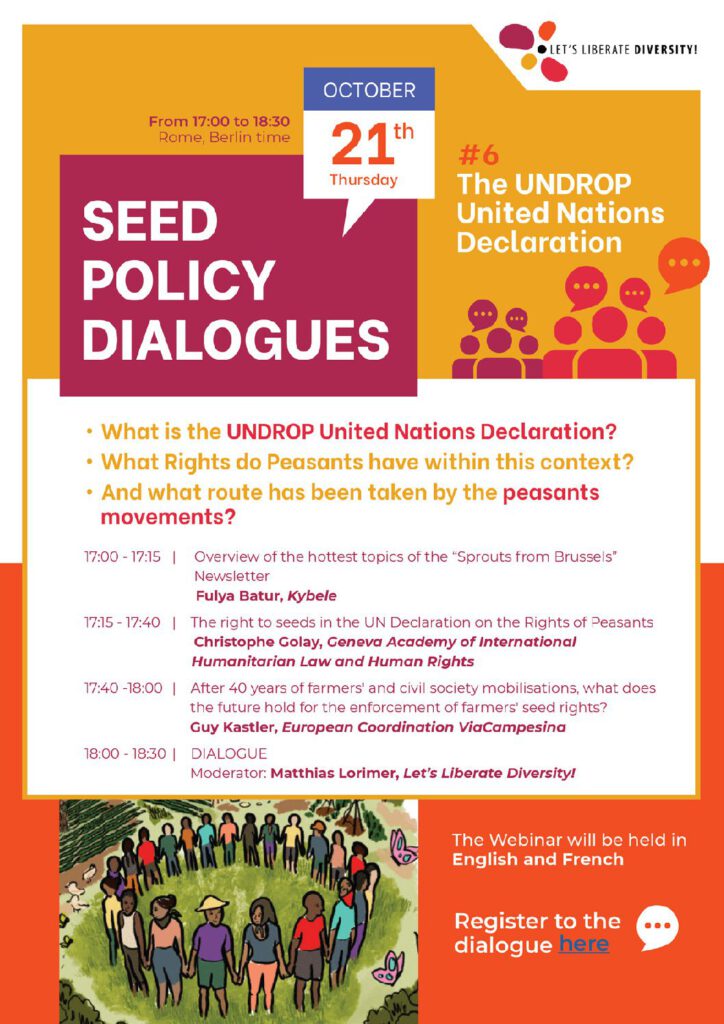
SPD#5: The FAO Treaty and Farmers’ Rights

After a summer break, the SPD started again in September 2021, focusing this time on the FAO International Treaty on Plant Genetic Resources for Food and Agriculture (ITPGRFA), and the notion of farmers’ rights. The dialogue gave an overview of the ITPGRFA itself, and its latest updates, especially on farmers’ rights, and asked what perspective and actions were of interest in the European context. It was enriched by contributions from Mario Marino, from the ITPGRFA Secretariat, and Riccardo BOCCI, from the Rete Semi Rurali network.You can re-watch (in English) the update from Brussels, the presentation from the ITPGRFA Secretariat on Farmers’ Rights: background and implementation, and on the implementation of farmers’ rights in Europe.

Sprouts from Brussels – Fulya Batur

Seed Marketing Reform – Responses to Inception Impact Assessment

Following the publication of the #EuropeanCommission’s inception impact assessment on 15th June 2021, we analyse in detail the feedbacks that were given by different stakeholders in the public consultation process.

ITPGRFA Secretariat on Farmers’ Rights: background and implementation -Mario Marino

In this webinar, we will talk about the historical path, the recognition and the meaning of Farmers’ Rights and the Art. 9 ( i)Rights that farmers have to save, use, exchange, and sell farm-saved seed/propagating material, ii)protection of traditional knowledge, iii)participation in making decisions, iv) equitable participation in sharing benefits).

Mario Marino, from the FAO Treaty Secretariat, updates us with the latest issues of the past Governing Body and invite us to continue sharing our examples of measures and best practices and lessons learned from the realization of Farmers’ Rights!

For further information: Follow Let’s Liberate Diversity! issues at https://liberatediversity.org/newslet…

FARMERS’ RIGHTS http://www.fao.org/plant-treaty/areas…

Or write to: info@liberatediversity.org PGRFA-Treaty@fao.org

The FAO Treaty: Implementation of Farmers’ rights in Europe – Riccardo Bocci

In this presentation, Riccardo Bocci of Rete Semi Rurali talks about the role Europe can play in the farmers’ rights process and his experience in the expert groups of the Europe region. To conclude what could be the vision of a platform that brings together different actors for the on-farm, in situ management of agrobiodiversity.

Useful links and readings:

1. PDF version of September’s “Sprouts from Brussels” or you could read online here: https://liberatediversity.org/seed-marketing-reform-responses-to-inception-impact-assessment/

2. Full-text version of the International Treaty on Plant Genetic Resources for Food and Agriculturehttp://www.fao.org/3/i0510e/i0510e.pdf
3. Specific Educational module on Farmers’ Rights http://www.fao.org/3/cb5497en/cb5497en.pdf
4. All the info regarding Farmers’ Rights http://www.fao.org/plant-treaty/areas-of-work/farmers-rights/information-resources/en/

a seed exchange during the Let's Liberate Diversity! Forums

A European network for agricultural biodiversity

Over the past four years, the partners of the European DYNAVERSITY project have analysed and described the networks and actors involved in the dynamic management of agrobiodiversity. The main objective is the consolidation and enlargement of the on-farm network...

No Results Found

The posts you requested could not be found. Try changing your module settings or create some new posts.

May 2026
No event found!
Load More

Video