Let’s Liberate Diversity! News
80 percent of European citizens say NO to patents on seeds
No Patents on Seeds! publishes a representative survey conducted in five EU member states
- France, Germany, Italy, the Netherlands and Poland surveyed.
- Results clearly show that around 80 percent of EU citizens reject the idea of granting patents on living organisms, e.g. patents on plants or animals.
- More than 70 percent said no to patents on naturally occurring genes.
- More than 90 percent responded with yes to the statements that diversity in plant breeding and food supply is crucial, and that environmental protection is particularly important when it comes to patents on genetically engineered plants and their market approval.
- No Patents on Seeds! is now demanding that the EU takes its responsibility to prohibit patents on plants and animals.

Importance of this survey for current EU policy
The survey was conducted by the opinion research institute Civey. One of the main reasons for conducting the representative survey was that EU member states and the European Parliament will soon be voting on a new law that would exempt food plants obtained from new genetic engineering (or new genomic techniques, NGTs) from existing risk assessment and labelling regulations. Depending on the outcome, this could vastly increase the number of seeds that are patented. The EU Parliament originally demanded that patents on plants and genetic resources were either prohibited or restricted. However, the compromise text that that the Council and EU parliament will soon vote on allows all NGT plants to be patented, including naturally occurring genes. Most NGT plants could be released without undergoing environmental risk assessment.
Non-government organisations denounce EU patent policy
“The picture is consistent in all five countries: the public rejects patents on seeds. A majority of EU citizens are very critical of patents on natural traits and want to see a precautionary approach when it comes to patents on genetically engineered plants and their environmental release,” says Nout van der Vaart from Oxfam Novib. “It is time for political decision-makers to take their responsibilities seriously and stop patents on seeds in the EU. They must also place more importance on securing diversity in plant breeding and the protection of the public goods.”
“All genetically engineered crops, including NGTs, are patented, but seed corporations like Bayer, BASF and Syngenta even claim patents on conventional crops. In this way they drive other seed companies out of business so they can dominate the market even more”, Nina Holland from Corporate Europe Observatory warns “The patents block access for plant breeders to a wide variety of seeds, necessary for a resilient food system. In fact, we all will get dependent on the decisions of this handful of companies and the prices they set. That is why citizens clearly rejects such patents.”
“It is apparent that the perspective of the public was not sufficiently taken into account in preparing the current proposal for the future regulation of NGT plants. This needs to be corrected. We demand that the text is amended to stop patents on seeds, or that these are completely rejected,” says Martha Mertens from Friends of the Earth.
No Patents on Seeds! Coalition
No Patents on Seeds! is an international coalition of organisations actively protecting conventional plant breeders and farmers against the threat of increasing concentration in the seed markets. Therefore, No Patents on Seeds! supports the EU member states and members of the EU Parliament that are in favour of prohibiting patents on plants.
Read the results of the survey here
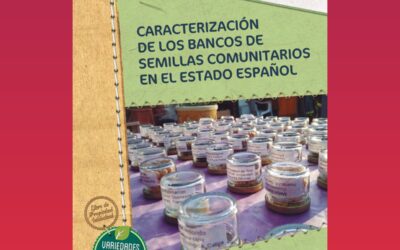
MAGHÁZ – A COMMUNITY SEED NETWORK IN HUNGARY
Community Seed Bank Labs – Workshop funded by the European Union through the Erasmus+ project Seeds of Growth (Project ID: KA210-ADU-1727BE52)
This presentation introduces Magház, a Hungarian community seed network focused on agrobiodiversity and seed saving. Founded informally in 2012 and formalised as an NGO in 2021, Magház comprises 18 core members and about 130 network members, operating 13+1 independent seed hubs across the country (gardens, small-scale farms and other local sites). The network maintains over 800 open‑pollinated varieties including landraces and engages in cooperation with the national gene conservation bank’s on‑farm programme. Key activities include seed swaps, seed saving courses, workshops, online educational materials (e.g. Seed Swap ‘Rules’, How To Organise a Seed Swap? in Hungarian), conservation education, and awareness raising. Magház participates in international projects such as COEVOLVERS (Horizon Europe, Oct 2022–Oct 2026, consortium partner) and Seeds of Change (Erasmus+, Jan 2025–Dec 2026, partner: FUG Graz), and has past collaborations including Salvia Foundation, Dynaversity, Farmer’s Pride and Arche Noah. The presentation outlines the network structure, operation of hubs, regular meetings (monthly/bi-monthly Zoom plus an annual in-person meeting), and channels for contact and outreach (maghaz.hu, maghazblog.blog.hu, @maghaz_hu).
Key topics: community seed network, agrobiodiversity, seed saving, seed swaps, community seed hubs, conservation education, Horizon Europe, Erasmus+
Strengthening Community Seed Banks and Sustainable Seed-Saving Practices in Europe (KA210-ADU-1727BE52) Community Seed Bank Labs WS 3
Community Seed Bank Labs – Workshop funded by the European Union through the Erasmus+ project Seeds of Growth (Project ID: KA210-ADU-1727BE52)
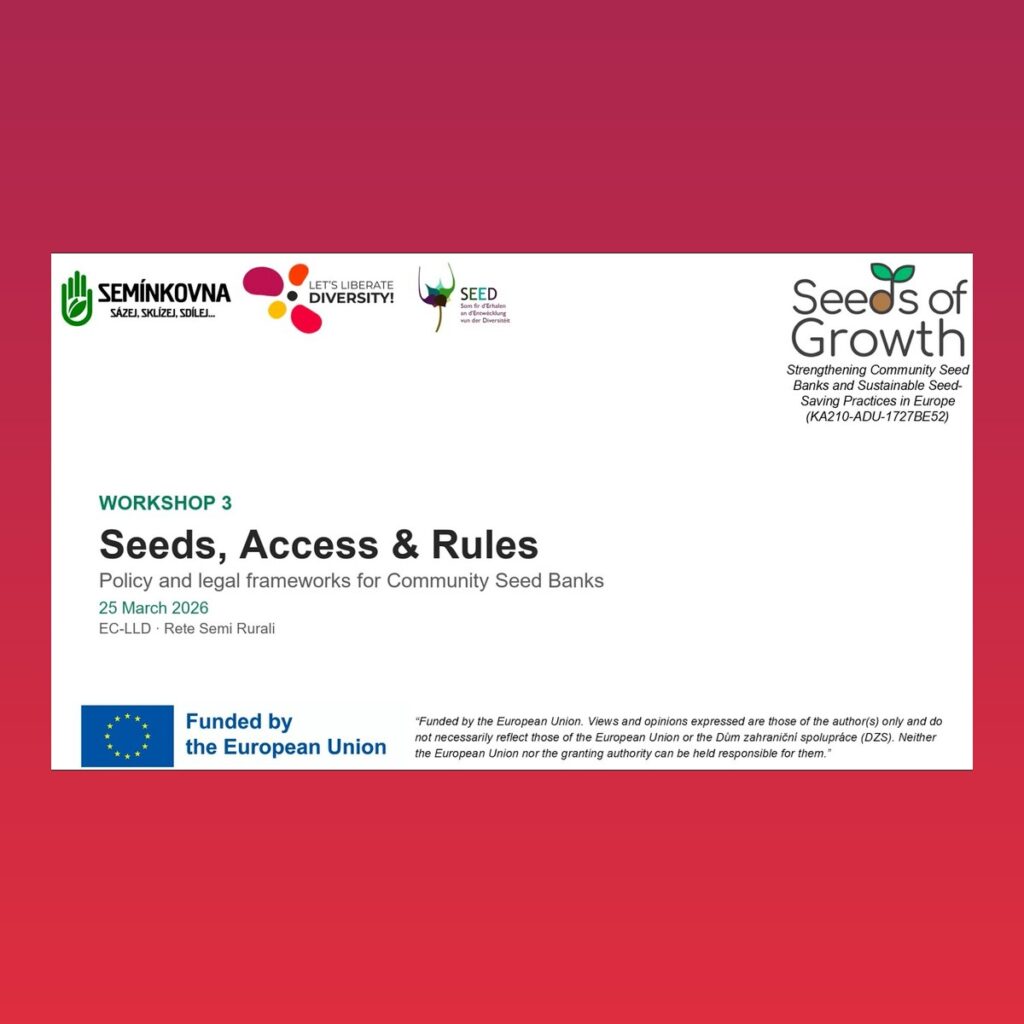
This slide presentation by Riccardo Bocci (Rete Semi Rurali) delivered in the Community Seed Bank Labs WS 3 examines policy and legal frameworks affecting community seed banks (CSBs) in Europe. It provides an accessible overview of international and EU-level instruments — including ITPGRFA, FAO processes, CBD, UPOV, and EU seed marketing/PRM rules — and explains how rules on DUS/VCU, conservation and heterogeneous variety derogations, phytosanitary requirements and seed certification shape CSB activities. The presentation addresses practical issues for CSBs: accessing ex situ germplasm, sharing and exchange (seed swaps, collective multiplication), registration and marketing options for heterogeneous materials, benefit-sharing and SMTA considerations, and definitions affecting gene banks. It also outlines sustainability and governance approaches for CSBs (capacity building, self-financing, participatory governance) and argues for greater recognition of informal farmers’ seed systems and supportive legal environments that enable farmers’ rights. Links to technical manuals and the DINAVERSITY project are provided for further practical guidance.
Key topics: community seed banks, seed policy, EU seed law, farmers’ rights, ITPGRFA, PRM regulation, access and benefit-sharing
Blacked-Out Ingredients campaign: defend transparency in food labelling
A Europe-wide campaign is calling on citizens and organisations to defend transparency in food labelling. The Blacked-Out Ingredients campaign warns that EU labels may soon no longer indicate whether food contains altered DNA, and invites people across Europe to take action, contact MEPs, and share the campaign materials widely.
Ahead of the European Parliament vote expected on 18 May, the campaign raises concern that, if the proposed law passes, food labels would no longer inform consumers whether food contains genetically modified organisms. Its core message is straightforward: consumers should continue to have access to clear information about what is in their food.
The campaign was initiated by organisations from the organic and environmental sector, including Demeter, Friends of the Earth Europe, and Bioland, and is open to all organisations and individuals who consider this issue important for consumers. Its aims are to encourage the European Parliament to maintain consumer labelling also for new GMOs, and to inform as many people as possible about the proposed changes and their implications.
The campaign website offers practical ways to get involved. It is available in multiple languages and includes WhatsApp and Telegram channels, and a downloads section with visuals and videos for sharing.
Find out more at the campaign website and help disseminate it across your networks https://www.blacked-out-ingredients.eu/
Read the latest newsletter of the Buzuruna Juzuruna network!
The 2025-2026 newsletter of the Buzuruna Juzuruna network is out! A short excerpt of the content: news from the region Ancient Cereals Festival farm work and experiments seed and seedling distribution campaigns news on training and education news from the HoBob...
Sign letter of support to our Malaysian colleagues
Malaysian smallholder farmers urge their government to not join UPOV1991
UPOV 1991 is an international intellectual property regime that grants exclusive monopoly rights to commercial breeders over seeds and planting material for 20 years or more.
Why is UPOV1991 harmful?
- Farmers’ Rights: UPOV 1991 outlaws age-old farmer practices of freely using, saving, exchanging and selling farm-saved seeds central to smallholder farming.
- Food Security: Small-scale farmers feed around 70% of the world’s population. Weakening their right to seeds and their seed systems threatens seed and food sovereignty.
- Biodiversity: UPOV favours uniform commercial varieties. Today, just nine crops account for over 60% of global production, accelerating genetic erosion.
- Legal & Economic Pressure: Seed monopolies have led to lawsuits, fines and rising seed prices, pushing farmers into dependency on corporate seed markets.
- Biopiracy: UPOV 1991 does not allow safeguards against biopiracy of native varieties and seeds, thereby undermining farmers rights including the rights of indigenous peoples and local communities.
Stand in solidarity with Malaysian smallholder farmers by signing their open letter
Our colleagues at APREBES have forwarded us the open letter that will be presented to the Prime Minister of Indonesia and request that as many organisations as possible sign. The deadline to sign is January 10th.
See full letter in English and Spanish.
Please share this call with other networks and organisations.
Blacked-Out Ingredients campaign: defend transparency in food labelling
A Europe-wide campaign is calling on citizens and organisations to defend transparency in food labelling. The Blacked-Out Ingredients campaign warns that EU labels may soon no longer indicate whether food contains altered DNA, and invites people across Europe to take action, contact MEPs, and share the campaign materials widely.
Ahead of the European Parliament vote expected on 18 May, the campaign raises concern that, if the proposed law passes, food labels would no longer inform consumers whether food contains genetically modified organisms. Its core message is straightforward: consumers should continue to have access to clear information about what is in their food.
The campaign was initiated by organisations from the organic and environmental sector, including Demeter, Friends of the Earth Europe, and Bioland, and is open to all organisations and individuals who consider this issue important for consumers. Its aims are to encourage the European Parliament to maintain consumer labelling also for new GMOs, and to inform as many people as possible about the proposed changes and their implications.
The campaign website offers practical ways to get involved. It is available in multiple languages and includes WhatsApp and Telegram channels, and a downloads section with visuals and videos for sharing.
Find out more at the campaign website and help disseminate it across your networks https://www.blacked-out-ingredients.eu/
How can municipalities help defend seed diversity in Europe?
A recent initiative from the Red de Municipios por la Agroecología (RMAe) offers a strong example!
In the context of the ongoing trilogue on the future EU Regulation on Plant Reproductive Material, the Spanish municipal network has sent a letter to the European institutions arguing that cultivated biodiversity and local seed systems are not abstract concerns: they are already part of concrete local food policies, and the new regulation should create conditions that support this work.
In its letter, RMAe stresses that municipalities are key actors in this debate and connects the seed policy debate with the role of municipalities in building sustainable, healthy and resilient local food systems, reinforcing the concept that seed diversity is not limited to the agricultural or breeding sphere alone, but is also linked to governance, territorial food strategies, public action and community-based initiatives.
RMAe’s proposal is grounded in the broader work developed around the 1st European Symposium “Fostering Cultivated Biodiversity through Local Food Policies”, held in Granollers on 29–30 April 2025, and in the resulting Granollers Manifesto. That process advanced a shared vision for European municipalities:
By 2050 all European municipalities will have a food policy that prioritises city-region based agri-food systems that delivers healthy and tasty food relying on cultivated biodiversity and locally adapted seeds using natural resources within the planetary boundaries while ensuring economically viable livelihoods to its communities and people.
The Granollers Manifesto positions cultivated biodiversity as a key lever for sustainable and healthy local food systems, and calls for action at municipal, regional, national and European levels. It includes 32 strategic actions for municipalities and a set of broader legislative, policy and financial demands to create long-term enabling conditions.
The letter also draws on evidence and examples compiled through the Horizon Europe LiveSeeding project, including the Manual on the Integration of Cultivated Biodiversity in Local Organic and Agroecology-oriented Food Policies. This paper documents how municipalities across Europe are already taking action to support cultivated biodiversity in practice. The examples highlighted in the letter range from community seed banks and support to local seed entrepreneurship, to participatory breeding, farmers’ markets, food processing initiatives and public food procurement linked to local and diverse varieties.
On this basis, RMAe calls on the trilogue negotiators to ensure that the future PRM Regulation provides a framework that protects and enables local seed systems, dynamic conservation, farmer-managed seed practices and community-based initiatives.
For EC-LLD, this is an important example of how cultivated biodiversity can be advanced through alliances between municipalities, civil society, researchers and local food system actors. It also shows the value of connecting European seed policy debates with territorial practice and local public policy.
European Patent Office tries to knock out European patent law
New rule was intended to prevent patents on traditional plant breeding 19 February 2026 / The European Patent Office has granted patent EP3720272 claiming traditionally-bred tomatoes with resistance to a plant virus (TBRFV) to the Dutch company Rijk Zwaan. The gene...