Let’s Liberate Diversity! News
Community seedbanks in Europe: their role between ex situ and on-farm conservation
This article enlightens the role of community seedbanks (CSBs) in Europe within the plant genetic resources for food and agriculture community and their role in the conservation and sustainable use of agrobiodiversity in complementarity with the ex situ management system. For more than 40 years, CSBs around the world have emerged as part of the so-called informal seed system to counteract the loss of locally adapted varieties through the development of collective seed systems. Most of the studies and articles refer to experiences from the Global South, whereas a comprehensive analysis of the impact and role of CSBs on seed systems in industrialized countries is still missing. This paper provides three case studies describing the community seed banking experience of different European organizations: Pro Specie Rara (Switzerland), Arche Noah (Austria) and Rete Semi Rurali (Italy). These organizations exemplify the diversity among European CSBs and their efforts to engage with genebanks and the formal seed system.
Community Seed Banks
PDF: https://www.genresj.org/index.php/grj/article/view/genresj.OHNK3179/264
HTML: https://www.genresj.org/index.php/grj/article/view/genresj.OHNK3179/265
More info: https://www.genresj.org/index.php/grj/article/view/genresj.OHNK3179
Let’s Liberate Diversity! Forum 2025 – Registration Now Open
We are excited to announce that registration is now open for the Let’s Liberate Diversity! Forum 2025, co-organised by Let’s Liberate Diversity!, Lycée Technicque Agricole (LTA), SEED Luxembourg, and LUGA Join us in Luxembourg from 4 to 6 September 2025 for a...
Launch of the DiverSeedPaths Booklet on EU Seed Policy and Legislation
The DiverSeedPaths project is proud to announce the release of its latest publication, “Capacity Building on European Seed Policy and Legislation”. This practical and accessible resource is designed to empower farmers, seed savers, policymakers, and...
Protecting crops through plant diversity
The INRAE has recently published a free-to-download eBook by the title ‘Protecting crops through plant diversity‘ in the context of project Ecophyto 2+ meant to reduce the use of synthetic pesticides to protect public health. This book is intended for research and teaching purposes, as well as agricultural, environmentaland citizen stakeholders.
Natural regulation of pest populations through agrobiodiversity is at the heart of this publication, which considers managing diversity in the landscape and the fields, including by increasing inter- and intraspecific diversity. It also makes reference to policy, both the EU CAP and the French National Strategic Plan.
CREDIT: This document came to our attention in the June 2024 Issue of the FAO Agroecology Knowledge Hub Digest, which we have previously written about
The Organic Advice Network
A new initiative was launched in the spring 2024 as part of the EU Farm to Fork Strategy and aligned to its target of achieving 25% organic farmland by 2030. The project aims to address the urgent need for skilled advisors in organic farming by creating and...
Series of surveys on forgotten crops – Radiant EU
Within the RADIANT EU project, the organisers of this survey exercise aim to support European policies and strategies that release the full value of neglected or forgotten crops and plant species within the food value chain. While in fact the current socio-economic...
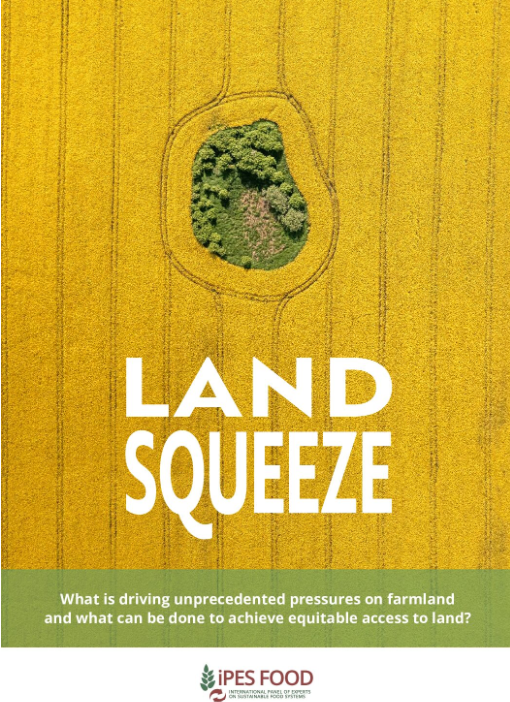
Land Squeeze – New release from the IPES Food
The struggle for land and the preservation of seed diversity are deeply interconnected. As land is increasingly monopolized by large entities, the diverse farming systems maintained by small-scale farmers and seed savers are being eroded.
As mentioned in the latest IPES report “Land Squeeze“, the access to and control over land has been shaped by long-standing processes of discrimination, oppression, and dispossession. Today, farmers, pastoralists, Indigenous Peoples, and marginalized groups are facing renewed threats as the pressures on land evolve and multiply, while new generations face huge barriers to accessing land and entering agriculture”
Drivers of Land Squeeze
The report released by IPES Food presents 4 drivers of what they call Land Squeeze:
Driver 1. Land grabbing 2.0: deregulation, financialization & rapid resource extraction
Driver 2. Green grabbing: big conservation, offsets & the green energy agenda
Driver 3. Expansion & encroachment: mining, urbanization, and mega-infrastructure developments
Driver 4. Food system reconfiguration: agri-food sector industrialization & consolidation

IPES Food recommendations
The recommendations from the IPES Food report provide a roadmap for addressing the drivers of the Land Squeeze and ensuring that land and agricultural resources remain in the hands of those who are best equipped to steward them—farmers, pastoralists, Indigenous Peoples, and marginalized communities.
- Build integrated land, environmental, and food systems governance to halt green grabs and ensure a just and human rights-based transition.
- From commodity to community: get speculative capital out of land markets and get land into the hands of farmers.
- Forge a new social contract, and a new generation of land and agrarian reforms.
FAO resources on millets
2023 was International Year of Millets (IYM2023) and all the resources collected and created during last year’s events are now available online.
These include a series of webinars detailing the social, economic and environmental benefits of millets, plants with a vast heritage and enormous potential.
Recipe booklets are also available to enable use of these resilient plants.
SAVE the DATE – 13th LLD Forum 2024 at Sow Your Resistance, in France
The European Coordination Let’s Liberate Diversity! invite you to participate in the LLD Forum from the 3rd o the 5th of October in the beatiful city of Antibes, France.
Let’s come together, exchange and learn together about cultivated diversity and dynamic seed management!
This edition of the Forum is hosted at the International farmer seed gathering “Sow Your Resistance” with an unique programme offering a wide range of activities, events and workshops. There is one unique registration that gives you access to both the International meeting and the 13th edition of the LLD Forum.
When:
- Field visits (optional) : 1 October – 2 October
- LLD Forum/International farmer seeds gathering : 3 October – 5 October
Where:
- Field visits : in different farms in France/Italy (see map)
- LLD Forum/International farmer seeds gathering : In the beautiful city of Antibes, France