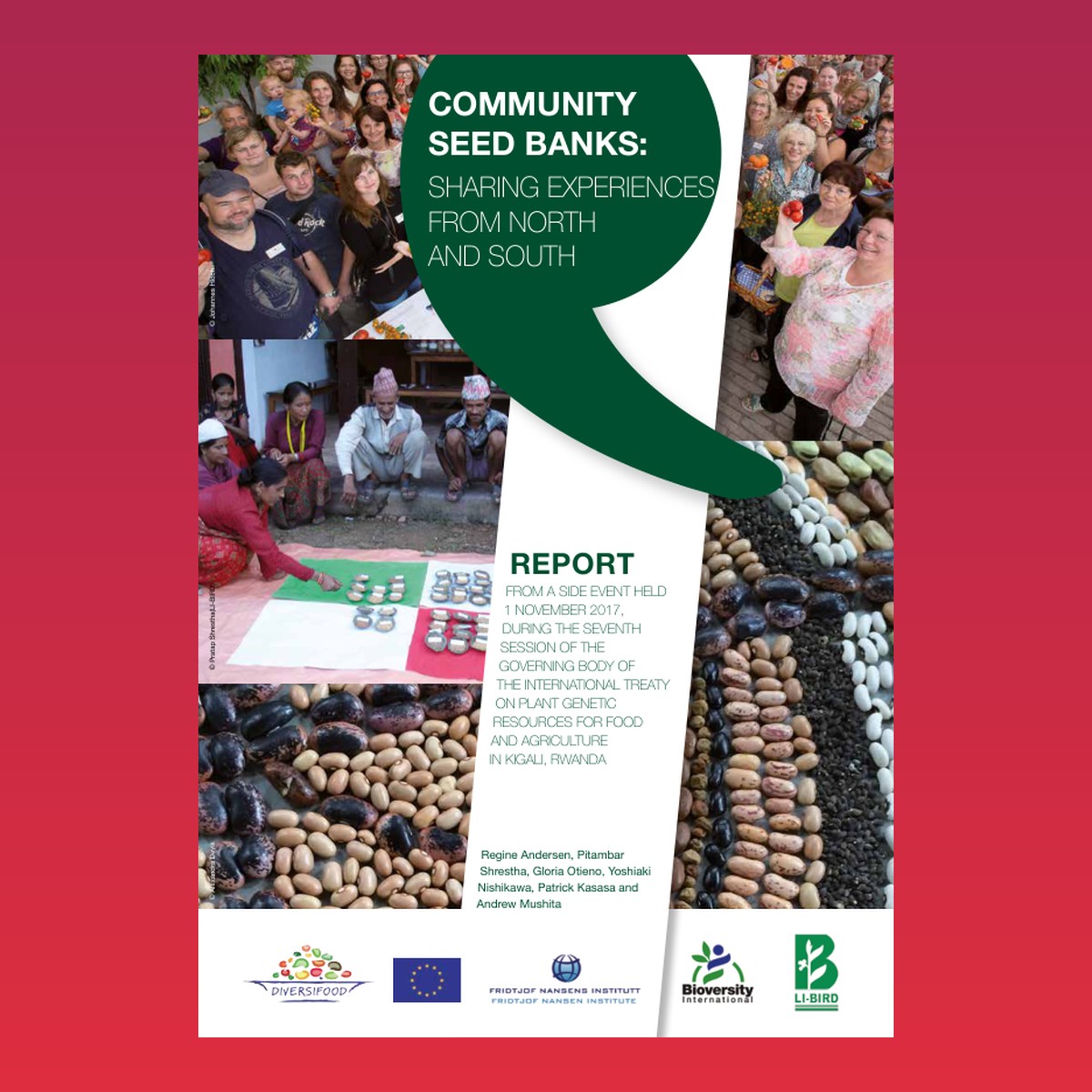
Side event at the Seventh Session of the Governing Body of the International Treaty on Plant Genetic Resources for Food and Agriculture, Kigali, Rwanda (1 November 2017)
This report documents a side-event (1 November 2017, Kigali) on community seed banks held during the Seventh Session of the Governing Body of the International Treaty on Plant Genetic Resources for Food and Agriculture. It presents findings from two major studies — the Bioversity International volume Community Seed Banks: Origins, Evolution and Prospects and a DIVERSIFOOD survey of European initiatives — and summarizes case studies from Japan, Uganda, Zimbabwe and Nepal. Key messages highlight the rapid global growth and diversity of community seed banks (different aims, governance and technical approaches), their roles in conserving and making available local crop varieties, and their contributions to farmers’ seed security, food sovereignty and participatory breeding. The report identifies core elements for sustainability: capacity development, models for self-financing, enabling legal and political frameworks, adequate physical infrastructure, social structures and systematic planning. The DIVERSIFOOD survey (85 respondents) found at least 130 initiatives in Europe, grouped regionally, with common achievements in awareness-raising, training and seed multiplication and common barriers including limited funding, manpower and unfavourable legal environments. The report also summarizes Governing Body decisions relevant to community seed banks, notably encouragement to Contracting Parties to promote sustainable biodiverse production systems, participatory approaches (including community seed banks) and the development of national action plans to realize Farmers’ Rights.
Key topics: community seed banks, farmers’ rights, seed conservation, seed systems, agrobiodiversity, participatory plant breeding, seed policy