Manual explaining international and EU frameworks (CBD/Nagoya, ITPGRFA), practical ABS tools (SMTA/Easy-SMTA) and scenarios for how Community Seed Banks and farmers can access, share and manage germplasm.

Discusses how community seed banks can conserve local varieties and improve agrobiodiversity by enhancing economic sustainability through legal recognition, market integration, partnerships and financing models.

Technical booklet describing experimental designs, statistical methods and the PPBstats R tools for decentralized on‑farm breeding and participatory plant breeding.

Report of a DIVERSIFOOD survey and Rome workshop (Sept 2017) mapping 84 European community seed banks: their diversity, activities (conservation, seed exchange, training, PPB), challenges (funding, capacity, regulation) and strategies (networking, advocacy).

Policy recommendations from the DIVERSIFOOD project to embed crop genetic diversity in food value chains, covering legal status of heterogeneous cultivars, CAP coherence, value chains, awareness and multi-actor research.
Practical guide (DIVERSIFOOD Booklet #2, 2019) for participatory evaluation, multiplication and on‑farm testing of underutilised genetic resources, covering seed sourcing, phenotypic assessment, performance, quality and trial organisation.

Report of a 22 Sept 2017 FAO workshop (DIVERSIFOOD/Bioversity/ITPGRFA) summarising CSB roles, case studies and a SWOT: CSBs are vital for dynamic conservation, access to local seed and participatory breeding but need policy recognition, funding and capacity.
Report (side event, 1 Nov 2017) summarising global experiences with community seed banks, a DIVERSIFOOD European survey, case studies (Japan, Uganda, Zimbabwe, Nepal), sustainability factors and Governing Body decisions on Farmers’ Rights.

Policy recommendations from DIVERSIFOOD to embed agrobiodiversity in European seed systems: promote Community Agrobiodiversity Management, support community seed banks, establish national PGRFA platforms, and harmonise seed laws.

Collective DIVERSIFOOD publication defining nine key concepts to guide embedding crop diversity and multi-actor innovation for resilient, locally adapted high-quality food systems.
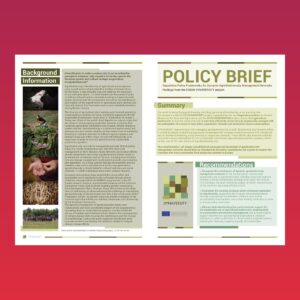
DYNAVERSITY policy brief calling for EU policy to support dynamic, networked on-farm management of agrobiodiversity through coordination, funding, participatory breeding and alignment with CAP, Farm to Fork and ITPGRFA.

DYNAVERSITY‘s summary of five key concepts for agrobiodiversity: seeds and varieties, seed networks, conservation (in situ/ex situ), governance (ITPGRFA, farmers’ rights), and diverse agroecological food systems.

DYNAversity/URGENCI report mapping CSA practices on cultivated biodiversity (75 responses, 13 countries). Finds mixed use of modern and traditional seeds, limited direct consumer roles, and recommends training, communication and stronger CSA–seed network links.
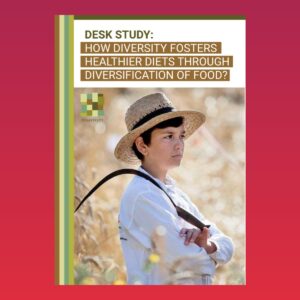
Desk study examining links between agrobiodiversity and health; compares institutional, technology‑centred (biofortification) and civil‑society discourses; highlights nutrient decline, varietal differences, and the need for holistic agroecological approaches.

ECPGR (2017) concept proposing a European strategy for on-farm conservation of PGRFA, with five priorities: inventory, indicators, good practices, agro-diversity sites, and legal/technical solutions.
Showing 31-45 of 84 results
The Seed Knowledge Hub has been developed within the context of the Erasmus+ project Seeds of Growth: Strengthening Community Seed Banks and Sustainable Seed-Saving Practices in Europe (Project ID: KA210-ADU-1727BE52)

Funded by the European Union. Views and opinions expressed are those of the author(s) only and do not necessarily reflect those of the European Union or the Dům zahraniční spolupráce (DZS). Neither the European Union nor the granting authority can be held responsible for them.