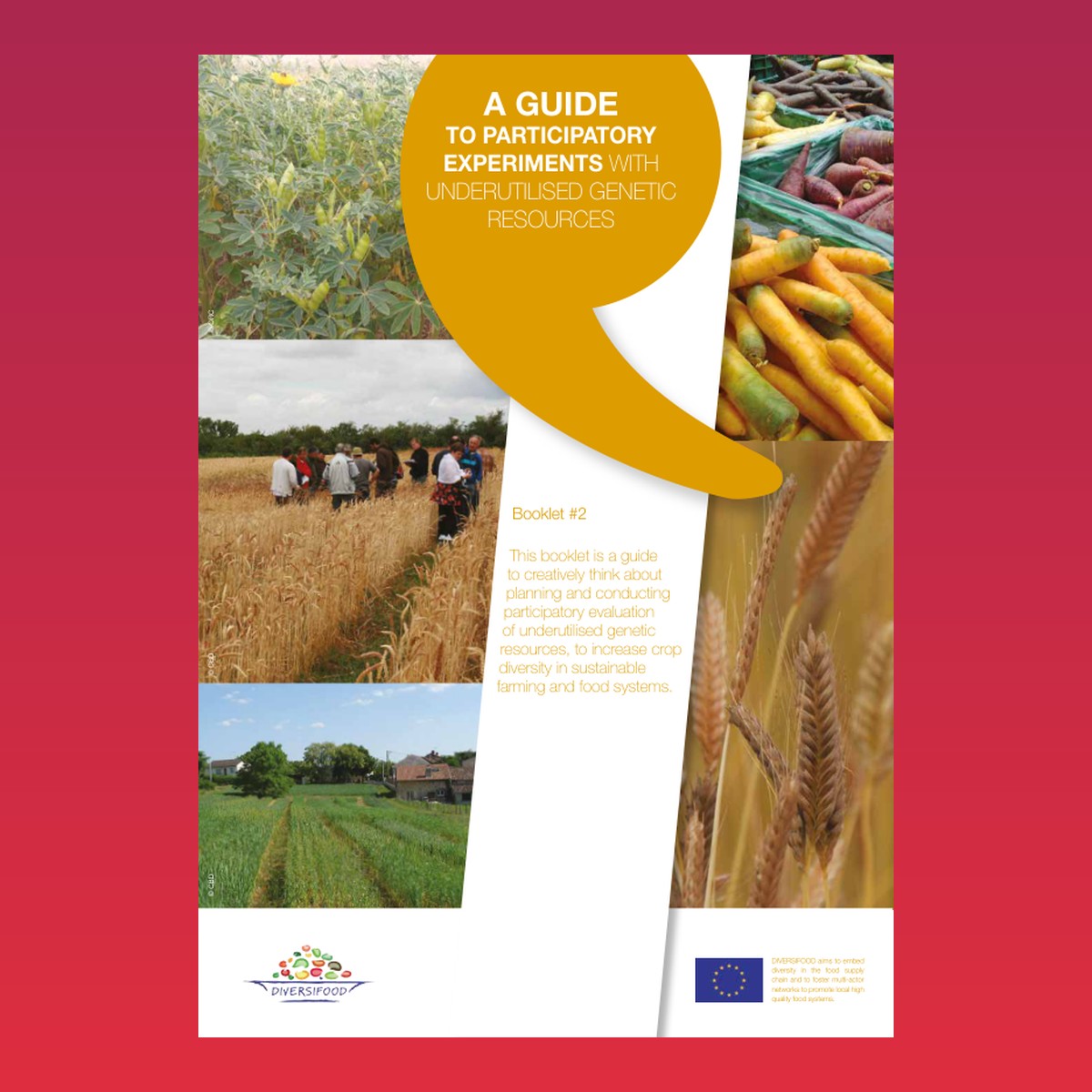
DIVERSIFOOD Booklet #2
This booklet (DIVERSIFOOD Booklet #2) provides practical guidance for planning and conducting participatory evaluation of underutilised genetic resources to increase crop diversity in sustainable farming and food systems. Produced within the DIVERSIFOOD project, it explains why and how to mobilise seeds from gene banks and other sources, highlights limitations of ex‑situ accessions (small seed quantities, limited passport data, conservation selection), and presents a pragmatic three‑step approach: produce a crop monograph, gather a large panel of accessions, and carry out multiplication and observation. The guide covers designing participatory experiments and trials, sourcing and multiplying seed, phenotypic descriptors and phenology (including BBCH scales), assessing agroecosystem performance (cover, vigour, health), productive performance and yield components, quality (processing, nutritional and organoleptic), and sensory methods (e.g. napping). It illustrates methods with examples (rivet wheat, brassicas, bread‑making tests) and gives practical organisational advice on plot sizes, seed amounts, harvesting, data management and multi‑location testing. The booklet targets researchers, farmers and multi‑actor networks engaged in on‑farm breeding, evaluation and deployment of diverse crops and emphasises testing across varied farm environments to identify context‑adapted, diversified populations and support value chains. It lists DIVERSIFOOD partners and notes EU Horizon 2020 funding.
Key topics: underutilised genetic resources, participatory evaluation, plant breeding, seed sourcing, phenotypic evaluation, agroecosystem performance, quality assessment, community seed systems