The Seed Knowledge Hub was built to keep the answers in one place. It is an open online repository hosted on the EC-LLD website, developed within Seeds ofGrowth, an Erasmus+ small-scale partnership in adult education (KA210), coordinated bySemínkovna (Czech Republic) with EC-LLD and SEED Luxembourg as partners.
The Hub brings together guides, technical manuals, case studies and policy materials on seed saving and cultivated diversity. What was included into it was decided on the basis of a capacity gap analysis that reached 868 people across Europe and collected 140 responses from seed savers, community seed bank managers and seed librarians.
The collection now holds over 80 resources and its growing thanks to the contributions of EC-LLD Members and the broader community. In the Seed Knowledge Hub you can also find the material from the LLD forums. The Hub grows with what the community puts into it. If your organisation has produced a guide, a manual, a template, a study or a policy briefing that others could use, write to info@liberatediversity.org and we will add it. Material in any European language is welcome.

Pan-European strategy (GenRes Bridge, 2021) with recommendations to conserve, characterise, monitor and sustainably use plant, animal and forest genetic resources; calls for coherent policy, capacity, funding and info systems.
Presentation of FiBL’s organic pre-breeding programme for white lupin in Switzerland, targeting anthracnose resistance, earliness and low alkaloid content through pedigree selection and composite cross populations.
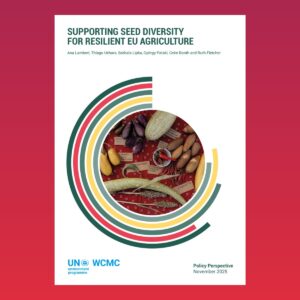
Policy brief recommending PRM reform and CAP/Horizon support to enable proportionate seed rules, recognise community seed custodians, fund participatory breeding and knowledge platforms to strengthen EU seed diversity and resilience.
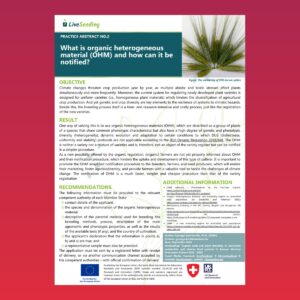
Explains Organic Heterogeneous Material (OHM) and the simplified EU notification route under Regulation 2018/848, required information for notification, and recommendations to promote uptake among breeders and farmers.
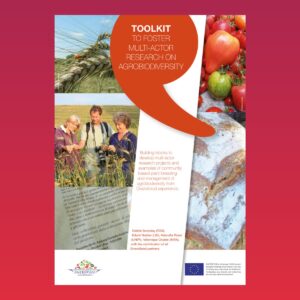
Practical toolkit from Diversifood with building blocks, case examples and methods to run multi-actor participatory plant breeding projects that boost on-farm agrobiodiversity.
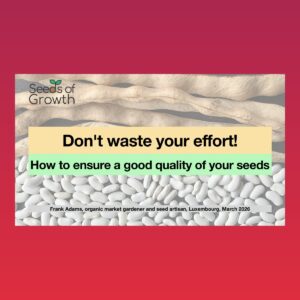
Community Seed Bank Labs – Workshop funded by the European Union through the Erasmus+ project Seeds of Growth (Project ID: KA210-ADU-1727BE52)
Practical workshop on on‑farm vegetable seed quality: harvesting, drying, cleaning, testing and storage, with tips on equipment, humidity control, labelling and seed‑stock management.
Community Seed Bank Labs – Workshop funded by the European Union through the Erasmus+ project Seeds of Growth (Project ID: KA210-ADU-1727BE52).
Presentation on EU and international policy frameworks for community seed banks, covering access to germplasm, EU seed/PRM rules, DUS/VCU, heterogeneous materials, benefit-sharing and practical implications for CSB governance and sustainability.
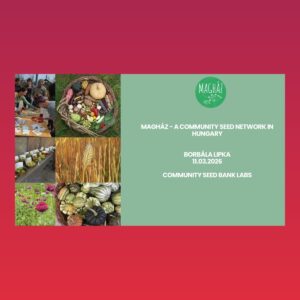
Community Seed Bank Labs – Workshop funded by the European Union through the Erasmus+ project Seeds of Growth (Project ID: KA210-ADU-1727BE52)
Overview of Magház, a Hungarian community seed network (est. 2012, NGO 2021) detailing hubs, seed saving (800+ varieties), seed swaps, education and projects (COEVOLVERS, Seeds of Change).
Community Seed Bank Labs – Workshop funded by the European Union through the Erasmus+ project Seeds of Growth (Project ID: KA210-ADU-1727BE52)
Overview of Community Seed Banks: origins, core functions, activities, differences with seed libraries, and the Seeds of Growth aim to strengthen seed-saving and CSBs across Europe.
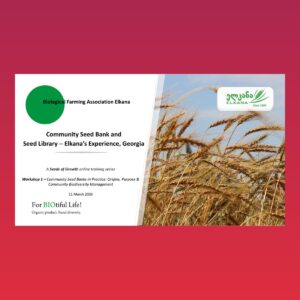
Community Seed Bank Labs – Workshop funded by the European Union through the Erasmus+ project Seeds of Growth (Project ID: KA210-ADU-1727BE52)
Elkana presents its Seed Ark farm, Community Seed Bank and Seed Libraries in Georgia, detailing seed multiplication, annual renewal and farmer seed‑share practices to conserve landraces and support agrobiodiversity, livelihoods and local seed systems.
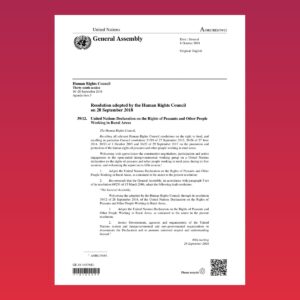
UN Declaration (A/HRC/RES/39/12, 2018) defining rights of peasants and rural workers, covering land, seeds, food sovereignty, participation, social protection and access to natural resources.
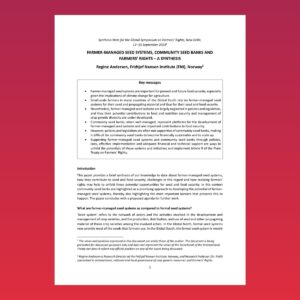
Synthesis on farmer-managed seed systems and community seed banks: their importance for seed security, legal and policy barriers, and a policy agenda to realize Farmers’ Rights.
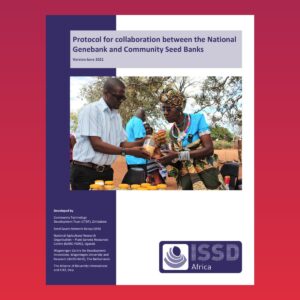
A June 2021 protocol defining roles, principles and practical rules to guide collaboration between national genebanks and community seed banks, covering capacity building, seed exchange, Prior Informed Consent and joint activities.
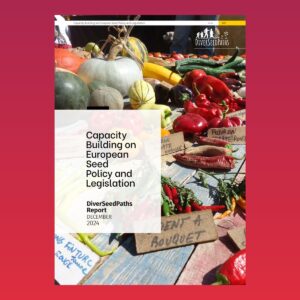
DiverSeedPaths (Dec 2024) report on EU seed policy and the PRM marketing reform, analysing impacts on seed diversity and farmers’ rights and offering practical advocacy steps.
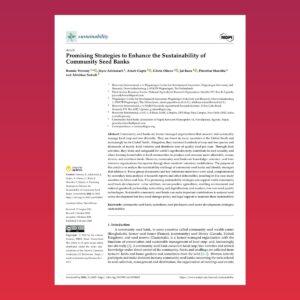
Analysis of sustainability challenges for community seed banks (India, Kenya, Nepal, South Africa, Uganda) and five strategies to enhance viability: value addition, nature-positive agriculture, genebank partnerships, networking/digitalization, and low-cost seed-quality tech.
Showing 1-15 of 83 results
The Seed Knowledge Hub has been developed within the context of the Erasmus+ project Seeds of Growth: Strengthening Community Seed Banks and Sustainable Seed-Saving Practices in Europe (Project ID: KA210-ADU-1727BE52)

Funded by the European Union. Views and opinions expressed are those of the author(s) only and do not necessarily reflect those of the European Union or the Dům zahraniční spolupráce (DZS). Neither the European Union nor the granting authority can be held responsible for them.