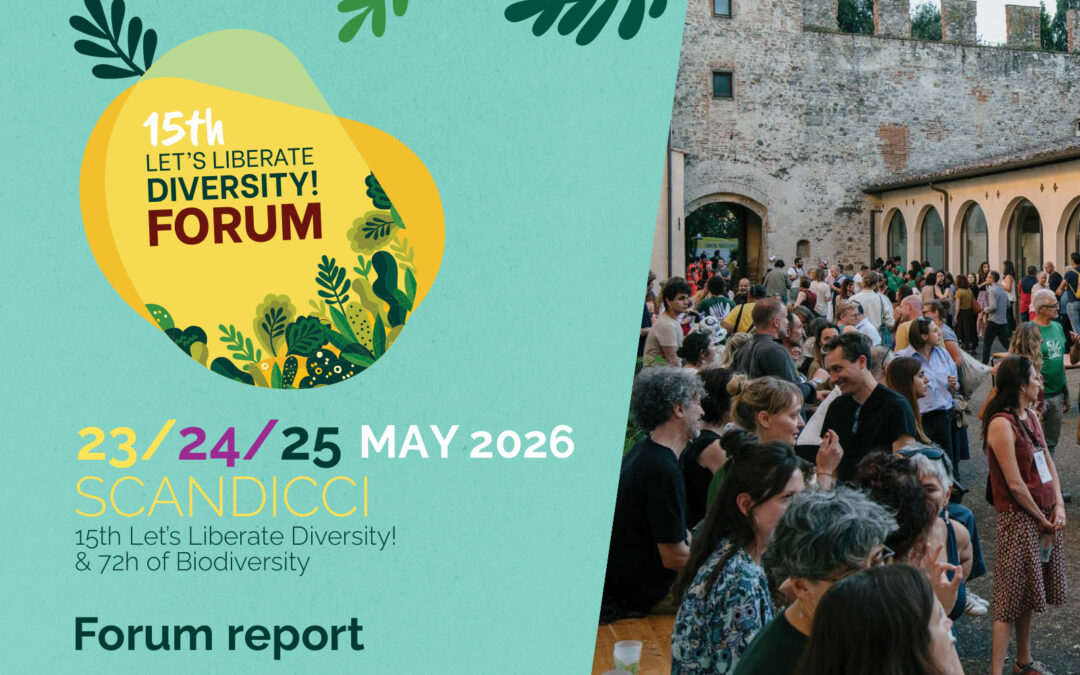
The final report of the 15th Let’s Liberate Diversity! Forum, held in Scandicci (Florence), Italy, on 23–25 May 2026, is now available. The edition was co-organised and hosted by Rete Semi Rurali, the Italian EC-LLD member, and took place within the “72 Hours of Biodiversity” festival at the Castello dell’Acciaiolo.
Download the report
15th Let’s Liberate Diversity! Forum – Scandicci 2026 – Final report (PDF)
The Forum in numbers
- 117 participants from 34 countries and around 90 organisations
- 9 thematic workshops in three rooms
- more than 30 speakers and facilitators
- 66 participants registered for the field visit
Among the participants were farmers, seed savers, breeders, researchers and academics, advisors and consultants, students, NGO and civil-society representatives, policy makers and a journalist.
Room 1 / LiveSeeding
Three of the nine workshops were dedicated to the Horizon project LiveSeeding, and shared key outcomes and reflections emerging from the project as it comes to a close. The sessions focused on local food policy, the right to food, and living labs in relation to organic breeding and agroecological transition.
LiveSeeding Organic seed and plant breeding to accelerate sustainable and diverse food systems in Europe – runs from 2022 to 2026 and is coordinated by FiBL Europe. It is funded by Horizon Europe as an Innovation Action, together with the Swiss State Secretariat for Education, Research and Innovation and UK Research and Innovation (grant agreement 101059872), and brings together 37 partners across 16 European countries. EC-LLD and Rete Semi Rurali are among them. A large part of its work runs through a network of 17 Living Labs.
WS1. Seeds, Biodiversity and the Right to Food: The Role of Municipal Food Policies
Facilitated by Mariano Iossa. The session used the right to food as the frame linking biodiversity, food policy and rights. It addressed two gaps: the weak legal foundations for food policy at EU level, and the limited integration of seed systems into food-policy frameworks.
WS4. Enhancing Cultivated Biodiversity through Local Food Policies
Moderated by Maria Carrascosa (Red de Semillas) and Francesca Gori (Rete Semi Rurali), with Nadia Tonoli (Bergamo Municipality), Vicenç Planas Herrero (Granollers City Council), Michela Tudini (FAO – ITPGRFA) and Francesca Cagnola (MUFPP). The workshop worked through concrete experiences from Bergamo and Granollers and connected local action to the multilevel governance changes needed to support municipalities. Organised by Red de Semillas, EC-LLD, Rete Semi Rurali and LiveSeeding.
WS7. Agroecology Living Labs: Crossfertilization for Promoting Agrobiodiversity
With Judit Fehér (KVANN/ÖMKi), Korinna Varga (ÖMKi), Francesca Gori (Rete Semi Rurali) and Virag Nagypal (ÖMKi). The session looked at Living Labs as collaborative spaces where farmers, researchers and agri-food stakeholders co-design and validate agroecological solutions in real-world settings, with an emphasis on cross-fertilisation and peer learning across European territories. Organised by LiveSeeding, ÖMKi, Rete Semi Rurali and the Agroecology Partnership.
WS1 and WS4 both build on a line of work that LiveSeeding has developed with the Spanish Network of Municipalities for Agroecology and Granollers City Council, and that runs from the 1st European Symposium “Fostering Cultivated Biodiversity through Local Food Policies” (Granollers, April 2025) to the Granollers Manifesto and, through it, to Resolution 5/2025 adopted by the Governing Body of the Plant Treaty in Lima in November 2025.
The other two rooms
Room 2 / Seed policy and political framing covered WS2 “Seeds in Common: Genebanks, Breeding Innovation, and the Future of Democratic Seed Systems”, WS5 “EU Seed Law Reform: What Does It Mean for Fields and Plates, and How Can We Safeguard Seed Diversity?” and WS8 “Plant Variety Protection, NGTs and Patents”.
Room 3 / Community-based experiences and movement building covered WS3 “On-farm Agrobiodiversity in the Balkan Region”, WS6 “Farmers’ Seed Systems in the Region of Central Asia and Eastern Europe” and WS9 “Affectionate Alliances and Exploratory Mindsets: Building a Global Coalition of Agroecological Seed Networks for Evolutionary Radical Futures”.
The programme also included a tasting activity on food prototypes from Crop Wild Relatives, organised by COUSIN project partners UCP (Universidade Católica Portuguesa), and a field visit to Rosario Floriddia in Peccioli (PI). The report closes with the list of organisers and supporters and the list of participants who agreed to share their information.
The Forum was organised by EC-LLD, Rete Semi Rurali and the 72 Hours of Biodiversity festival, with the support of LiveSeeding, SALVIA, ECO-PB, COUSIN and the Municipality of Scandicci.