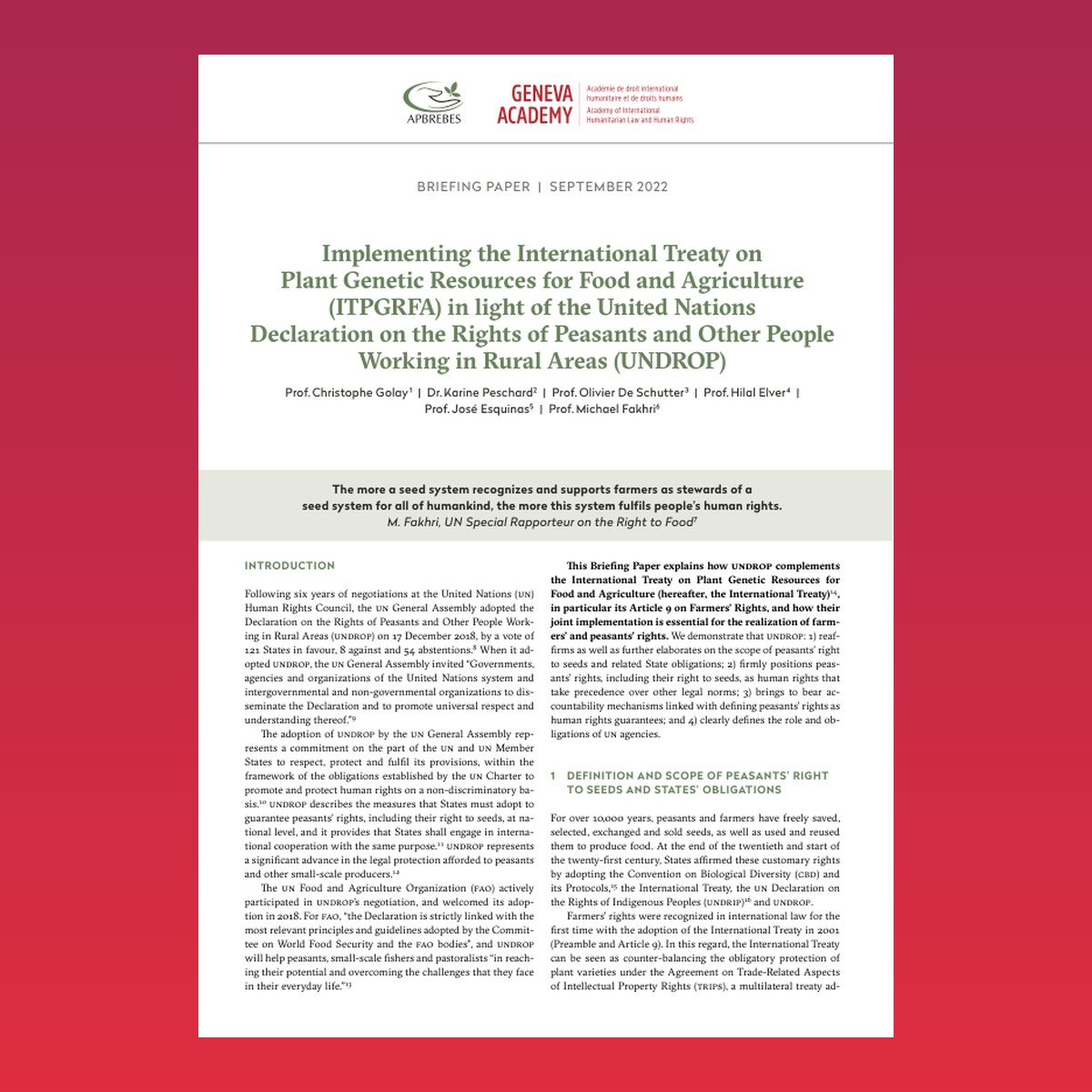
Briefing Paper
This briefing paper explains how the United Nations Declaration on the Rights of Peasants and Other People Working in Rural Areas (UNDROP) complements and strengthens implementation of the International Treaty on Plant Genetic Resources for Food and Agriculture (ITPGRFA), in particular Article 9 on Farmers’ Rights. It argues that UNDROP: clarifies and expands the scope of peasants’ right to seeds and State obligations; affirms the primacy of human rights over conflicting legal norms (including trade and intellectual property rules); links peasants’ rights to enforceable accountability mechanisms; and defines obligations for UN agencies such as FAO and the Treaty Secretariat to support implementation. The paper highlights national and regional jurisprudence invoking UNDROP and related instruments (e.g. UNDRIP, ICESCR, CEDAW) and stresses that seed policies, certification, plant variety protection and other IP laws must respect peasants’ rights. It calls for increased cooperation between FAO, the International Treaty Secretariat and UN human rights bodies to ensure Treaty implementation aligns with international human rights obligations.
Key topics: UNDROP, ITPGRFA, farmers’ rights, seed policy, human rights, FAO, intellectual property